Fluree AI Enterprise AI Data Intelligence
Fluree Core Knowledge Graph Intelligent Database
Fluree Sense Structured Data AI Data Cleansing
Fluree CAM Unstructured Data Auto Content Tagging
Fluree ITM Taxonomy Manager Controlled Vocabularies
Fluree HQ 486 Patterson Ave Ste 221 Winston-Salem, NC 27101 – – –
Fluree NY 222 Broadway New York, NY, 10038 – – –
Fluree India 5th Floor, Trifecta Adatto, c/o 91 Springboard Business Hub Pvt Ltd, 21 ITPL Main Rd, Garudachar Palya, Near Phoenix Mall, Karnataka-560048 India
Fluree CO 14143 Denver West Parkway, Suite 100 Golden, CO 80401 – – –
Fluree EMEA 18, rue de Londres 76009 Paris, France
Hype cycles lead to impulsive adoption. It’s what they’re designed to do. But enterprises aren’t falling for it this time. When it comes to generative AI, pilot projects are in motion. Yet most enterprises refuse to connect their proprietary data to LLMs or other AI agents.
Security teams are in the dark about important questions. Will generative AI providers disclose information to others? Will someone be able to uncover proprietary information with a clever prompt? How safe is our data really?
The data confirms their concerns. According to IBM’s 2025 Cost of a Data Breach Report, 97% of organizations that experienced AI-related breaches lacked basic access controls. The threat isn’t hypothetical.
The SaaS boom left too much data exposed to bad actors. Generative AI will, if anything, both complicate security problems and accelerate breaches. Enterprises want to be proactive, not reactive, and rightfully so. The stakes are too high to learn as we go. Teams are looking to layer on policies, securities, and permissions from the very start, to enable safe use of generative AI without exposing data where it doesn’t belong.
During the SaaS boom of the 2010s, organizations adopted apps more quickly than security solutions could keep pace. Lured by low total cost of ownership and easy scaling, teams rapidly accumulated SaaS software. Software ate the world, to paraphrase venture capitalist Marc Andreessen. Companies that had used a handful of business applications suddenly found themselves managing multitudes of SaaS vendors.
It’s now normal to use dozens of SaaS applications, each with its own integration points, APIs, and third-party connections. The convenience of SaaS comes at a cost. 43% of organizations have reported SaaS-related security incidents since 2019. The average enterprise spends around $1 million annually on incident response and recovery from SaaS-related attacks and data breaches.
SaaS apps and enterprise databases create a sprawling attack surface where a single misconfiguration, unvetted integration, or overlooked permission can expose sensitive data. Since security controls are often inconsistent across apps, attackers only need to exploit the weakest link to gain entry.
The ultimate goal of generative AI is to delegate more tasks to AI agents. These agents exist in the sprawling infrastructure of enterprise SaaS. When you give agents permissions to access to sensitive data and let them to act without human oversight, the SaaS attack surface increases even more. Blind spots grow bigger and breaches accelerate.
Agents relying on third-party models and APIs inherit pre-existing vulnerabilities, which attackers can exploit. A compromised agent can expose data and perform malicious action, moving laterally between multiple SaaS applications and APIs. SaaS tools often default to permissive sharing, so AI tools that scrape or auto-share data can increase unintentional data exposure. Because agents operate at machine speed, and can execute decisions without human review, breaches and data exfiltration can happen before security teams detect them. And now AI is compounding the problem – shadow AI breaches cost organizations an average of $670,000 more than traditional incidents (IBM, 2025).
If data can’t be exposed without permission, and if an agent cannot move between APIs and SaaS tools without governance, many problems can be prevented. A combination of access controls, governance, and monitoring is in order so that we don’t enhance the security problems from the SaaS era.
Security teams want to track how generative AI is being used, and rightfully so. Most enterprise data projects remain stuck in the pilot phase—and for good reason. According to BigID’s 2025 AI Risk & Readiness Report, only 6% of organizations have an advanced AI security strategy in place. Meanwhile, Gartner predicts that 40% of AI-related data breaches by 2027 will stem from cross-border GenAI misuse if left unchecked.
I’ve seen a few attempts to address the problem.
One is adoption caution. Software vendors questionnaires to make sure their products are secure. One new question I’ve seen is: “Does the product have anything to do with generative AI?” Teams need to know where their data is going, and to whom.
I find these solutions circuitous. At Fluree, we’ve long included the ability for data to defend itself. Enterprises should be able to control where any of their data goes. Only full oversight will suffice.
Fluree offers the ability to embed policies into data itself, otherwise known as data-centric security. Data retains security policies regardless of where it is stored, processed, or accessed.
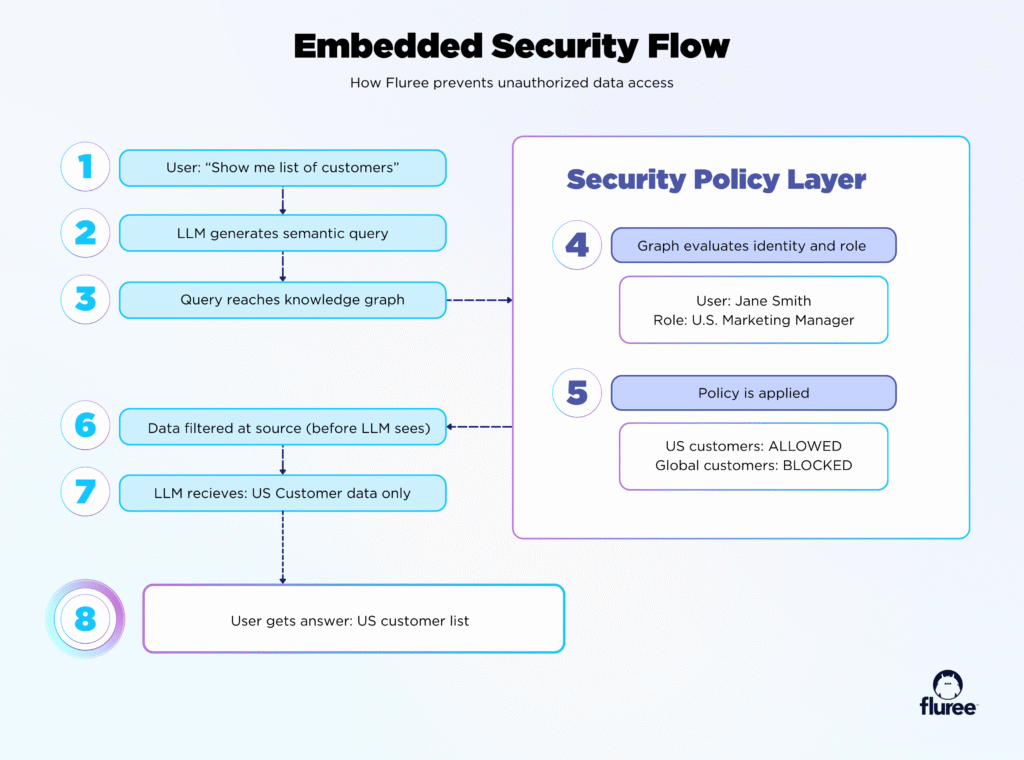
Security teams define who and how data can be contributed, used, and accessed. They can monitor the data as it moves through systems and users, enforcing identity and access management protocols along the way. Policies protect data no matter if there’s one line of code off in your API or if a lot of different users use a lot of different APIs. Moreover, data-centric security is naturally scalable.
When an LLM makes a query, you don’t just receive the answers—you also receive the security policies that were applied. This gives you complete traceability over the data. On top of that, you can reproduce any policy as it existed at a specific point in time, so if you ever need to audit something, that context is always available. You can review the applied policies in real time to verify compliance, or export them for governance and reporting purposes. If something looks off, you can adjust permissions instantly and confirm that the changes are enforced.
As a result, whether you’re using generative AI or not, data will be compliant with regulatory requirements, because policies and permissions are baked in. It will be a lot harder for attackers to access data, because it defends itself. You can update security policies across the board even in complicated infrastructures that include many generative AI agents.
The question isn’t whether AI will transform business operations—it’s whether we’ll learn from SaaS mistakes and secure these systems properly from the start.
📅 LIVE EVENT
A live demonstration of data-centric security for the age of AI agents, shadow AI, and autonomous enterprise systems.
REGISTER NOW
Fill out the form below to sign up for Fluree’s GenAI Sandbox Waitlist.
"*" indicates required fields
Semantic Partners, with its headquarters in London and a team across Europe and the US, is known for its expertise in implementing semantic products and data engineering projects. This collaboration leverages Fluree’s comprehensive suite of solutions, including ontology modeling, auto-tagging, structured data conversion, and secure, trusted knowledge graphs.
Visit Partner Site
Report: Decentralized Knowledge Graphs Improve RAG Accuracy for Enterprise LLMs
Fluree just completed a report on reducing hallucinations and increasing accuracy for enterprise production Generative AI through the use of Knowledge Graph RAG (Retrieval Augmented Generation). Get your copy by filling out the form below.
Fill out the form below to schedule a call.
Fluree is integrated with AWS, allowing users to build sophisticated applications with increased flexibility, scalability, and reliability.
Semiring’s natural language processing pipeline utilizes knowledge graphs and large language models to bring hidden insights to light.
Industry Knowledge Graph LLC is a company that specializes in creating and utilizing knowledge graphs to unlock insights and connections within complex datasets, aiding businesses in making informed decisions and optimizing processes.
Cobwebb specializes in providing comprehensive communication and networking solutions, empowering businesses with tailored services to enhance efficiency and connectivity.
Deploy and Manage Fluree Nodes on Zeeve’s Cloud Infrastructure.
Visit Partner Site More Details
Sinisana provides food traceability solutions, built with Fluree’s distributed ledger technology.
Lead Semantics provides text-to-knowledge solutions.
TextDistil, powered by Fluree technology, targets the cognitive corner of the technology landscape. It is well-positioned to deliver novel functionality by leveraging the power of Large Language Models combined with the robust methods of Semantic Technology.
Project Logosphere, from Ikigai, is a decentralized knowledge graph that empowers richer data sets and discoveries.
Cibersons develops and invests in new technologies, such as artificial intelligence, robotics, space technology, fintech, blockchain, and others.
Powered by Fluree, AvioChain is an aviation maintenance platform built from the ground up for traceability, security, and interoperability.
Thematix was founded in 2011 to bring together the best minds in semantic technologies, business and information architecture, and traditional software engineering, to uniquely address practical problems in business operations, product development and marketing.
Opening Bell Ventures provides high-impact transformational services to C-level executives to help them shape and successfully execute on their Omni-Channel Digital Strategies.
Datavillage enables organizations to combine sensitive, proprietary, or personal data through transparent governance. AI models are trained and applied in fully confidential environments ensuring that only derived data (insights) is shared.
Vitality Technet has partnered with Fluree to accelerate drug discovery processes and enable ongoing collaboration across internal departments, external partners, and regulatory offices through semantics, knowledge graphs, and digital trust technologies.
SSB Digital is a dynamic and forward-thinking IT company specializing in developing bespoke solutions tailored to meet the unique needs and challenges of clients, ranging from predictive analytics and smart automation to decentralized applications and secure transactions.
Marzex is a bespoke Web3 systems development firm. With the help of Fluree technology, Marzex completed one of the first successful blockchain-based online elections in history.
Semantic Arts delivers data-centric transformation through a model-driven, semantic knowledge graph approach to enterprise data management.
Intigris, a leading Salesforce implementation partner, has partnered with Fluree to help organizations bridge and integrate multiple Salesforce instances.
Follow us on Linkedin
Join our Mailing List
Subscribe to our LinkedIn Newsletter
Subscribe to our YouTube channel
Partner, Analytic Strategy Partners; Frederick H. Rawson Professor in Medicine and Computer Science, University of Chicago and Chief of the Section of Biomedical Data Science in the Department of Medicine
Robert Grossman has been working in the field of data science, machine learning, big data, and distributed computing for over 25 years. He is a faculty member at the University of Chicago, where he is the Jim and Karen Frank Director of the Center for Translational Data Science. He is the Principal Investigator for the Genomic Data Commons, one of the largest collections of harmonized cancer genomics data in the world.
He founded Analytic Strategy Partners in 2016, which helps companies develop analytic strategies, improve their analytic operations, and evaluate potential analytic acquisitions and opportunities. From 2002-2015, he was the Founder and Managing Partner of Open Data Group (now ModelOp), which was one of the pioneers scaling predictive analytics to large datasets and helping companies develop and deploy innovative analytic solutions. From 1996 to 2001, he was the Founder and CEO of Magnify, which is now part of Lexis-Nexis (RELX Group) and provides predictive analytics solutions to the insurance industry.
Robert is also the Chair of the Open Commons Consortium (OCC), which is a not-for-profit that manages and operates cloud computing infrastructure to support scientific, medical, health care and environmental research.
Connect with Robert on Linkedin
Founder, DataStraits Inc., Chief Revenue Officer, 3i Infotech Ltd
Sudeep Nadkarni has decades of experience in scaling managed services and hi-tech product firms. He has driven several new ventures and corporate turnarounds resulting in one IPO and three $1B+ exits. VC/PE firms have entrusted Sudeep with key executive roles that include entering new opportunity areas, leading global sales, scaling operations & post-merger integrations.
Sudeep has broad international experience having worked, lived, and led firms operating in US, UK, Middle East, Asia & Africa. He is passionate about bringing innovative business products to market that leverage web 3.0 technologies and have embedded governance risk and compliance.
Connect with Sudeep on Linkedin
CEO, Data4Real LLC
Julia Bardmesser is a technology, architecture and data strategy executive, board member and advisor. In addition to her role as CEO of Data4Real LLC, she currently serves as Chair of Technology Advisory Council, Women Leaders In Data & AI (WLDA). She is a recognized thought leader in data driven digital transformation with over 30 years of experience in building technology and business capabilities that enable business growth, innovation, and agility. Julia has led transformational initiatives in many financial services companies such as Voya Financial, Deutsche Bank Citi, FINRA, Freddie Mac, and others.
Julia is a much sought-after speaker and mentor in the industry, and she has received recognition across the industry for her significant contributions. She has been named to engatica 2023 list of World’s Top 200 Business and Technology Innovators; received 2022 WLDA Changemaker in AI award; has been named to CDO Magazine’s List of Global Data Power Wdomen three years in the row (2020-2022); named Top 150 Business Transformation Leader by Constellation Research in 2019; and recognized as the Best Data Management Practitioner by A-Team Data Management Insight in 2017.
Connect with Julia on Linkedin
Senior Advisor, Board Member, Strategic Investor
After nine years leading the rescue and turnaround of Banco del Progreso in the Dominican Republic culminating with its acquisition by Scotiabank (for a 2.7x book value multiple), Mark focuses on advisory relationships and Boards of Directors where he brings the breadth of his prior consulting and banking/payments experience.
In 2018, Mark founded Alberdi Advisory Corporation where he is engaged in advisory services for the biotechnology, technology, distribution, and financial services industries. Mark enjoys working with founders of successful businesses as well as start-ups and VC; he serves on several Boards of Directors and Advisory Boards including MPX – Marco Polo Exchange – providing world-class systems and support to interconnect Broker-Dealers and Family Offices around the world and Fluree – focusing on web3 and blockchain. He is actively engaged in strategic advisory with the founder and Executive Committee of the Biotechnology Institute of Spain with over 50 patents and sales of its world-class regenerative therapies in more than 30 countries.
Prior work experience includes leadership positions with MasterCard, IBM/PwC, Kearney, BBVA and Citibank. Mark has worked in over 30 countries – extensively across Europe and the Americas as well as occasional experiences in Asia.
Connect with Mark on Linkedin
Chair of the Board, Enterprise Data Management Council
Peter Serenita was one of the first Chief Data Officers (CDOs) in financial services. He was a 28-year veteran of JPMorgan having held several key positions in business and information technology including the role of Chief Data Officer of the Worldwide Securities division. Subsequently, Peter became HSBC’s first Group Chief Data Officer, focusing on establishing a global data organization and capability to improve data consistency across the firm. More recently, Peter was the Enterprise Chief Data Officer for Scotiabank focused on defining and implementing a data management capability to improve data quality.
Peter is currently the Chairman of the Enterprise Data Management Council, a trade organization advancing data management globally across industries. Peter was a member of the inaugural Financial Research Advisory Committee (under the U.S. Department of Treasury) tasked with improving data quality in regulatory submissions to identify systemic risk.
Connect with Peter on Linkedin
Turn Data Chaos into Data Clarity
Enter details below to access the whitepaper.
Pawan came to Fluree via its acquisition of ZettaLabs, an AI based data cleansing and mastering company.His previous experiences include IBM where he was part of the Strategy, Business Development and Operations team at IBM Watson Health’s Provider business. Prior to that Pawan spent 10 years with Thomson Reuters in the UK, US, and the Middle East. During his tenure he held executive positions in Finance, Sales and Corporate Development and Strategy. He is an alumnus of The Georgia Institute of Technology and Georgia State University.
Connect with Pawan on Linkedin
Andrew “Flip” Filipowski is one of the world’s most successful high-tech entrepreneurs, philanthropists and industry visionaries. Mr. Filipowski serves as Co-founder and Co-CEO of Fluree, where he seeks to bring trust, security, and versatility to data.
Mr. Filipowski also serves as co-founder, chairman and chief executive officer of SilkRoad Equity, a global private investment firm, as well as the co-founder, of Tally Capital.
Mr. Filipowski was the former COO of Cullinet, the largest software company of the 1980’s. Mr. Filipowski founded and served as Chairman and CEO of PLATINUM technology, where he grew PLATINUM into the 8th largest software company in the world at the time of its sale to Computer Associates for $4 billion – the largest such transaction for a software company at the time. Upside Magazine named Mr. Filipowski one of the Top 100 Most Influential People in Information Technology. A recipient of Entrepreneur of the Year Awards from both Ernst & Young and Merrill Lynch, Mr. Filipowski has also been awarded the Young President’s Organization Legacy Award and the Anti-Defamation League’s Torch of Liberty award for his work fighting hate on the Internet.
Mr. Filipowski is or has been a founder, director or executive of various companies, including: Fuel 50, Veriblock, MissionMode, Onramp Branding, House of Blues, Blue Rhino Littermaid and dozens of other recognized enterprises.
Connect with Flip on Linkedin
Brian is the Co-founder and Co-CEO of Fluree, PBC, a North Carolina-based Public Benefit Corporation.
Platz was an entrepreneur and executive throughout the early internet days and SaaS boom, having founded the popular A-list apart web development community, along with a host of successful SaaS companies. He is now helping companies navigate the complexity of the enterprise data transformation movement.
Previous to establishing Fluree, Brian co-founded SilkRoad Technology which grew to over 2,000 customers and 500 employees in 12 global offices. Brian sits on the board of Fuel50 and Odigia, and is an advisor to Fabric Inc.
Connect with Brian on Linkedin
Eliud Polanco is a seasoned data executive with extensive experience in leading global enterprise data transformation and management initiatives. Previous to his current role as President of Fluree, a data collaboration and transformation company, Eliud was formerly the Head of Analytics at Scotiabank, Global Head of Analytics and Big Data at HSBC, head of Anti-Financial Crime Technology Architecture for U.S.DeutscheBank, and Head of Data Innovation at Citi.
In his most recent role as Head of Analytics and Data Standards at Scotiabank, Eliud led a full-spectrum data transformation initiative to implement new tools and technology architecture strategies, both on-premises as well as on Cloud, for ingesting, analyzing, cleansing, and creating consumption ready data assets.
Connect with Eliud on Linkedin
Get the right data into the right hands.
Build your Verifiable Credentials/DID solution with Fluree.
Wherever you are in your Knowledge Graph journey, Fluree has the tools and technology to unify data based on universal meaning, answer complex questions that span your business, and democratize insights across your organization.
Build real-time data collaboration that spans internal and external organizational boundaries, with protections and controls to meet evolving data policy and privacy regulations.
Fluree Sense auto-discovers data fitting across applications and data lakes, cleans and formats them into JSON-LD, and loads them into Fluree’s trusted data platform for sharing, analytics, and re-use.
Transform legacy data into linked, semantic knowledge graphs. Fluree Sense automates the data mappings from local formats to a universal ontology and transforms the flat files into RDF.
Whether you are consolidating data silos, migrating your data to a new platform, or building an MDM platform, we can help you build clean, accurate, and reliable golden records.
Our enterprise users receive exclusive support and even more features. Book a call with our sales team to get started.
Fluree Core Enterprise Inquiry - General. Located on Fluree Core page.
Download Stable Version Download Pre-Release Version
Register for Alpha Version
By downloading and running Fluree you agree to our terms of service (pdf).
General Nexus Beta Sign Up; Eventually to be replaced with a landing page.