What Is AI Grounding? How to Tie AI Answers to Sources You Can Check

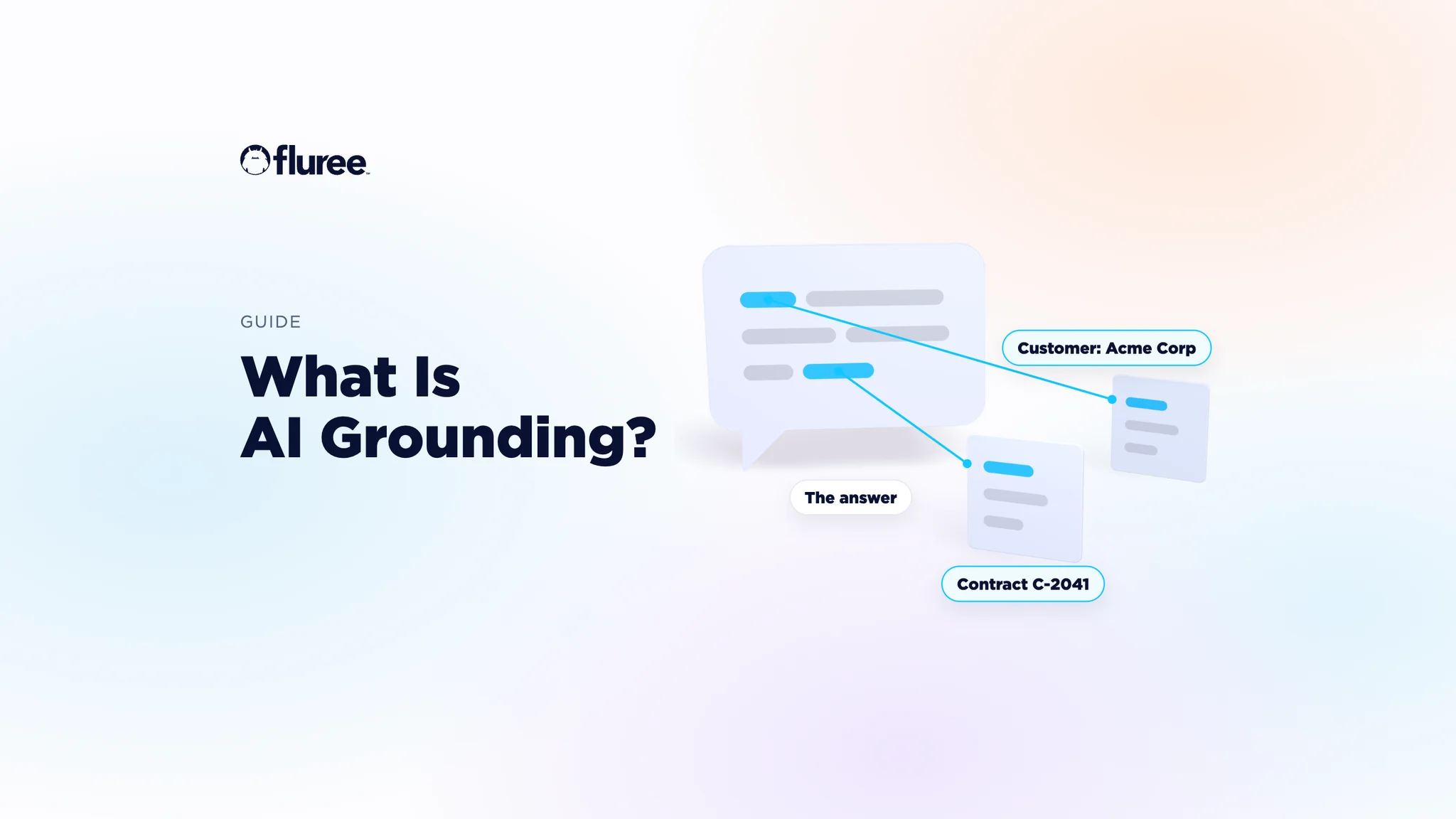
AI grounding means tying what a language model says to specific sources you can check, such as documents, database records, or search results, so that every claim in an answer can be traced to where it came from. A grounded answer stays within those sources. Groundedness measures how much of an answer the sources actually support.
Fluree grounds AI in a governed knowledge graph: every mention resolved to one record, every fact carrying its source and history, and access policy enforced on each fact before a model or agent sees it. This guide explains how grounding works in general, and where that approach fits.
What does grounding mean in AI?
The word has two meanings, and both still appear in the literature.
The original sense is the symbol grounding problem. In 1990 the cognitive scientist Stevan Harnad asked how symbols that a system manipulates by their shape alone could ever mean anything (Physica D, 1990). His answer was that meaning has to be grounded in something that is not more symbols, such as perception.
Today’s sense is source grounding. When engineers say a model is grounded, they mean its output is anchored to information outside the model. Google Cloud defines grounding as the ability to “connect model output to verifiable sources of information.” A 2023 paper by Bing Liu bridges the two: language models get source grounding from retrieval, but they still lack the deeper human kind.
This guide is about source grounding: how to make an answer traceable to records your organization trusts.
Grounded versus ungrounded: an example
Ask an assistant, “When is Acme’s renewal due?”
- Ungrounded: “Acme’s contract renews annually on January 1.” The model produced a plausible pattern from its training data. Nothing in your systems says this.
- Grounded: “Acme Corporation’s renewal is due March 3, under contract C-2041 (section 4.2).” The customer, the contract, and the clause are records you can open.
The second answer can still be wrong, but it can be checked, and that changes what you can do with it. In Fluree, the customer, the contract, and the clause are records in one knowledge graph, so the assistant can return their identifiers and the exact source text alongside the answer.
Why does grounding matter?
Language models generate the most probable next words, not the most accurate ones. Without grounding they fill gaps with fluent guesses. NIST’s Generative AI Profile (July 2024) lists this as a named risk, confabulation: confidently stated but false content.
The evidence that grounding helps, and that it is not enough on its own:
The pattern is consistent: retrieval and citations reduce hallucination but do not remove it. What the model is grounded in matters as much as the technique. In Fluree’s own 2024 GraphRAG accuracy study, questions answered over raw relational data scored 8–15% zero-shot, while the same questions over a governed knowledge graph started at 60–65% and passed 95% once the graph was enriched.
The rest of this guide is about the techniques, and about where they break.
How does AI grounding work?
Most grounded systems follow the same five steps, whatever the tools.
- Retrieve. Find candidate sources for the question: passages, records, search results.
- Resolve. Decide which real-world things the question and the sources are about: which customer, which contract, which product. This is entity linking, covered below.
- Generate. Give the model the sources and ask it to answer only from them.
- Cite. Return pointers from each claim to the passage or record that supports it.
- Check. Score whether the cited sources actually support the claims, and refuse or flag the answer when they do not.
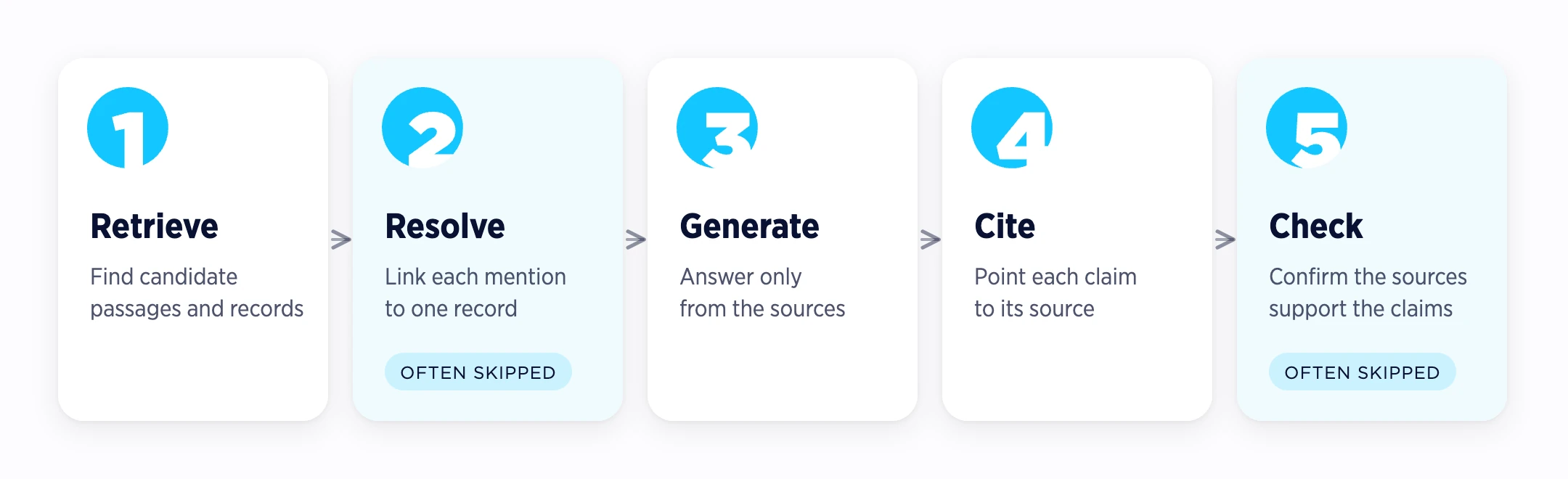
The five steps of a grounded answer. Most stacks do retrieve, generate, and cite; resolve and check are where answers are won or lost.
Grounding techniques compared
These are not alternatives so much as layers. A production assistant typically retrieves passages, links the entities they mention to records, calls a system of record for the exact values, and returns citations for each claim. Fluree puts those layers in one place: FlureeDB holds the records, the relationships, and vector and keyword search over them, and serves all of it to agents through MCP under one access policy. For a closer look at when graph retrieval outperforms vector retrieval, see GraphRAG vs. vector RAG.
Entity linking: the grounding step most stacks skip
Entity linking is the task of connecting mentions of entities in text to the records they refer to in a knowledge base. The standard survey, Shen, Wang, and Han (IEEE TKDE, 2015), breaks it into steps:
- Mention detection. Find the spans that name something: “Acme,” “the March renewal,” “C-2041.”
- Candidate generation. List the records each mention could refer to. “Acme” might match Acme Corporation, Acme Logistics, and Acme Inc. (UK).
- Disambiguation. Rank the candidates using context, such as the contract number in the same sentence or the account the user owns.
- NIL prediction. When the right record is not in the knowledge base, say so, rather than picking the closest match.
The idea dates back at least to Wikify! (2007), which linked words in documents to Wikipedia articles.
In Fluree, this is how documents enter the graph. Fluree AI Extract reads PDFs, Office files, HTML, and scans, finds the entities you already know, pulls out only the relationships your ontology allows, and lands every claim in the graph with the excerpt that proves it. Mentions resolve to the same records your systems use, so a contract clause and a CRM account end up on one customer.
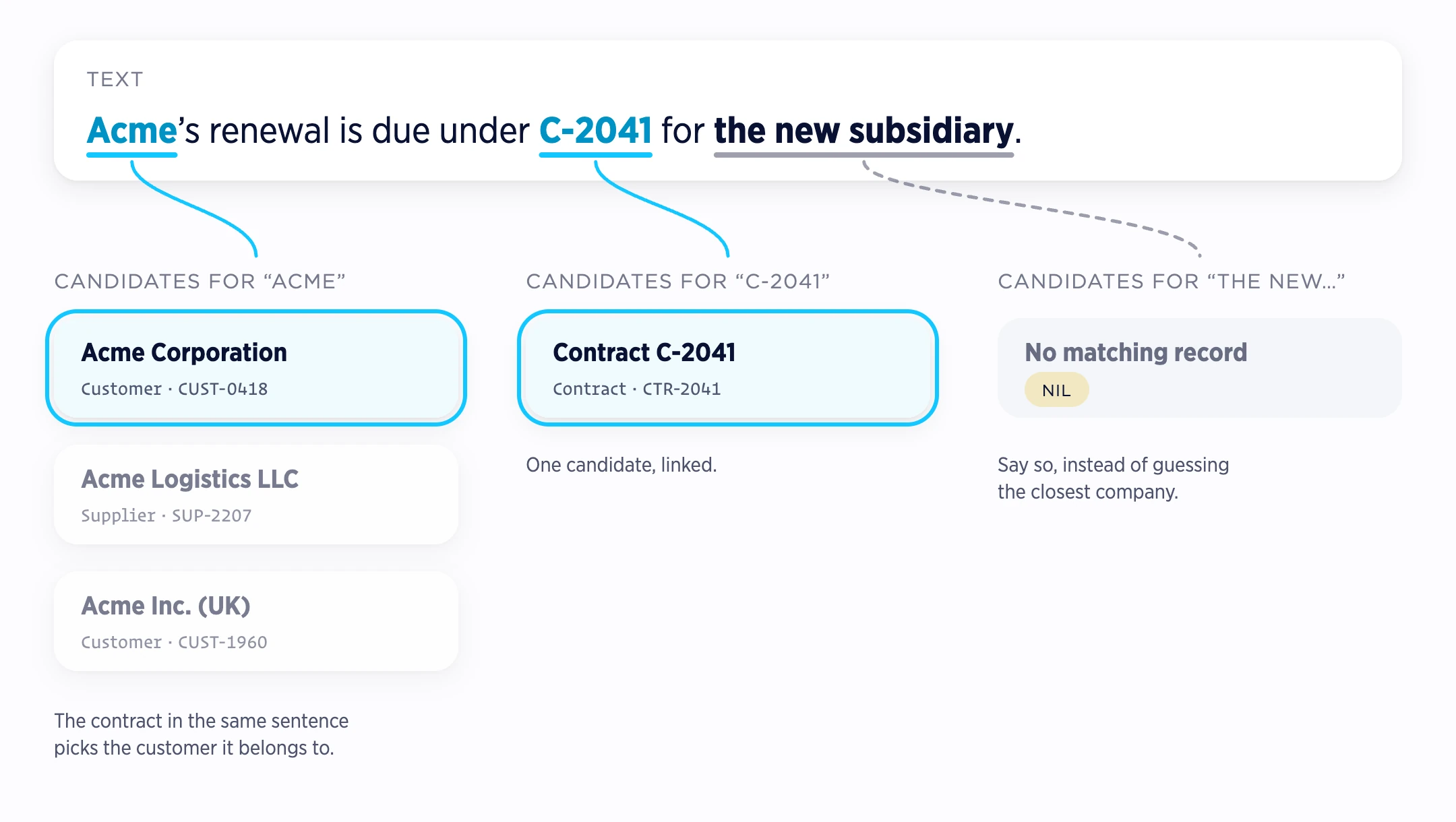
Entity linking turns mentions into record IDs. The NIL outcome matters as much as the match: it stops the system from guessing.
Why it matters for grounding
Retrieval answers “which passages look like this question?” Entity linking answers “which customer is this about?” Without it, an assistant that finds three documents mentioning “Acme” may blend facts about three different companies into one confident answer. The survey names name variations and ambiguity as the central difficulty, and enterprise data is full of both: “J. Smith,” “ACME CORP,” and a product code that changed in 2024.
Entity linking versus entity resolution versus NER
- Named entity recognition finds that “Acme” is an organization name. It does not say which organization.
- Entity linking connects the mention “Acme” to the record for Acme Corporation.
- Entity resolution works on records, not text: it decides that three customer records in three systems describe the same company. See what entity resolution is and how it works.
The two linking problems feed each other. Entity linking is only as good as the records it links to, and those records are only trustworthy after entity resolution has merged their duplicates into golden records.
What is groundedness, and how do you measure it?
Groundedness is the extent to which an answer is based on the information it was given. Microsoft’s documentation describes a grounded response as one that adheres closely to the given information.
The common ways to measure it:
Two practical notes. First, every claim-based metric uses a model as the judge, so calibrate it on a few hundred examples your experts have labeled. Second, measure groundedness on your own questions and sources. A model’s rank on a public leaderboard says little about how it handles your contract language.
Why grounding fails
Each of these failure modes is documented, and most production incidents involve more than one.
- The retrieval missed. The right passage never reached the model. Anthropic found that a chunk such as “revenue grew by 3%” loses the company and quarter it belonged to; adding that context to chunks cut failed retrievals by 35% to 67% in its tests.
- The model ignored what it was given. Models use information at the start and end of a long context better than information in the middle (“Lost in the Middle,” 2023).
- The entity was ambiguous. Facts about two companies called Acme were merged into one answer. Entity linking exists to stop this.
- The index was stale. The source changed after the search index was built. Microsoft’s engineers note that permissions copied into an index at ingestion stay stale until the next run, so a user whose access was revoked can still retrieve the content.
- The user saw what they should not. Retrieval runs with some identity’s permissions. Research on Microsoft 365 Copilot (ConfusedPilot, 2024) showed that over-privileged retrieval leaks data, and Microsoft Research argues that only deterministic enforcement of fine-grained access control at answer time reliably prevents it.
- The citation did not support the claim. A pointer to a real passage is not evidence that the passage says what the answer claims. Anthropic’s Citations API guarantees valid pointers; whether they support the claim still has to be checked.
- The source was wrong. A perfectly grounded answer repeats the error in its source. Grounding moves the question of truth from the model to the data, which is why the quality of the knowledge you ground on sets the ceiling.
Grounding, traceability, and regulation
No regulation requires “grounding” by name. Traceability is a different matter. The EU AI Act’s Article 12 requires high-risk AI systems to log events automatically over their lifetime, and the 2026 Digital Omnibus moved most of those high-risk obligations to December 2, 2027. In the United States, NIST’s Generative AI Profile treats confabulation as a risk to be managed.
In practice, a grounded system with structured citations and recorded sources is much easier to audit than one that is not. The answer, the sources it used, and the identity it ran under become a record that can be reviewed later.
How to ground AI answers in enterprise data
A short checklist, in the order most teams can act on it:
- Start from the questions. Collect a few hundred real questions and the records that answer them. That set becomes your evaluation.
- Resolve entities before you retrieve. Merge duplicate customers, products, and suppliers, and give each one stable identifier. Grounding on duplicates multiplies the ambiguity.
- Link text to records. Run entity linking on documents and on the question itself, and keep the NIL outcome.
- Enforce permissions at answer time, on the records and facts used, not only when the index was built.
- Return citations as data, with a pointer for every claim, and check that the cited passage supports it.
- Measure groundedness continuously, on your own question set, and treat a drop as an incident.
How Fluree grounds AI answers
Fluree is built around one idea: ground first, then generate. Before a model writes a word, the facts it may use are resolved, linked, sourced, and permissioned.
- Resolve your records. Fluree AI Resolve turns the customers, products, and suppliers spread across your warehouses, lakes, and operational systems into golden records, each with lineage to every source. That gives grounding one record to point to, not three.
- Link your documents. Fluree AI Extract links what documents mention to those records and keeps the excerpt behind every fact, so citations point to the exact words.
- Keep one vocabulary. Context Management maintains the taxonomies and ontologies that give each term one meaning across systems.
- Enforce policy on every fact. FlureeDB applies attribute, role, and relationship-based policy to each fact at query time, so an agent grounds only on what its user may see.
- Keep the receipts. Every change is a signed transaction, and the graph can be queried as it stood at any moment, so you can show what an agent knew when it answered.
- Serve it to any agent. Agents reach the graph through MCP or GraphRAG, with vector, keyword, and graph retrieval in one query.
The result is an answer whose every claim points to a record and a source, filtered for the person asking. See how to build a context layer for AI for the architecture.
Frequently Asked Questions
Stay in the loop
Weekly insights on enterprise AI, knowledge graphs, and data intelligence.