Guide to the Enterprise AI Context Layer

Every major data vendor now sells something called a context layer, and no two of them mean the same thing. Six new terms for the idea entered circulation in the fourteen months before this guide was written: context engineering, context database, context graph, context mesh, context layer, and AI context platform. Buyers are being sold five different things under one name.
This guide is our attempt to pin the term down. It defines the enterprise AI context layer, explains why AI agents fail without one, lays out the Four Tiers of Enterprise Context as a maturity model, separates the context layer from the things it gets confused with, and shows how to add one to the stack you already run.
What is an enterprise AI context layer?
An enterprise AI context layer is the governed layer between your data estate and your AI agents that turns fragmented enterprise data into trusted, queryable context: entities resolved, relationships explicit, policies enforced, and every answer traceable to versioned source.
Three nouns get used around this idea, and they do three different jobs:
- Enterprise context is the asset. It is what agents need and what most enterprises do not have in machine-readable form: the facts of the business, connected, with their meaning, their rules, and their history.
- The enterprise AI context layer is the architecture. It is the named tier in the stack that produces and serves enterprise context to every consumer, human or machine.
- The context graph is the substrate. It is the knowledge graph that carries decision context alongside the data: when something happened, what happened, why an action was taken, and who was allowed to see it.
The layer is not a catalog, a search index, or a prompt library, although each of those has been relabeled as one. It holds the data itself, made semantic, resolved, governed, and versioned. That distinction runs through the rest of this guide.
Why do AI agents fail without a context layer?
Agents fail without a context layer because the reference architecture most enterprises run today is optimized for the literal question, not the decision-grade one. It can tell you what revenue was last quarter. It cannot tell you whether the gap to plan was execution, market, or strategy, because the context needed to answer that is scattered across systems that do not agree on what a customer, a product, or a policy is.
Four failure modes show up in nearly every agent program that stalls:
- Entity identity does not resolve. “NVDA,” “Nvidia Corp,” and “NVIDIA Corporation” are three points in vector space and three rows in three tables. No agent can aggregate exposure cleanly until something decides they are one company.
- Multi-hop reasoning is not possible. “Which portfolio managers hold X, also wrote about Y, and report to mandate Z” cannot be answered by similarity search or by SQL joins improvised at runtime. It needs traversal over a relationship-rich model.
- Provenance does not survive scrutiny. When an agent makes a claim, regulators and CIOs will ask who said it, when, and based on which version of which document. Vector chunks and table rows do not carry versioned, audit-grade lineage.
- Controls multiply per agent. Access policies applied to raw tables get re-implemented inside each agent’s prompts and retrievers. That is the path to inconsistent enforcement, prompt-injection exposure, and audit findings.
The numbers behind this are not subtle. Gartner predicted in February 2025 that through 2026, organizations would abandon 60 percent of AI projects unsupported by AI-ready data. In MuleSoft’s 2025 Connectivity Benchmark, 80 percent of organizations named data silos the biggest barrier to their automation and AI goals. And in May 2026, Gartner’s Rita Sallam put it plainly: without context, a clear understanding of the specific relationships and rules within an organization’s data, AI agents cannot operate accurately.
The model is not the bottleneck. The substrate is. We wrote about the architectural consequence of that in Context-in-the-Loop.
What does a context layer contain?
A context layer holds five things, and it holds them as data rather than as configuration: facts, meaning, policy, history, and memory. If a product offers you fewer than five, it is a component of a context layer, not the layer.
The components map to three kinds of knowledge. Explicit knowledge is what is written down: records, documents, contracts. Implicit knowledge is what is true but never stated in one place: this supplier is also that customer, this policy applies to that region. Tacit knowledge is what only the people know: why the exception was granted, what was tried and abandoned, which number the board approved. A context layer that stops at explicit knowledge is a search index. Implicit knowledge comes from entity resolution and reasoning. Tacit knowledge comes from memory that records decisions as data.
Gartner’s research on the topic names three core components of a context layer for agents: semantics, operational state, and provenance, as summarized by Denodo. Meaning covers semantics. Facts and memory cover operational state. History covers provenance. We add policy as the fifth because, in our experience, it is the component that decides whether an agent can be trusted to act.
What are the Four Tiers of Enterprise Context?
The Four Tiers of Enterprise Context are a maturity model for how much of the business an AI system can reason about: descriptive, relational, evaluative, and reflective. Each tier answers a different question, and each requires capabilities the tier below does not.
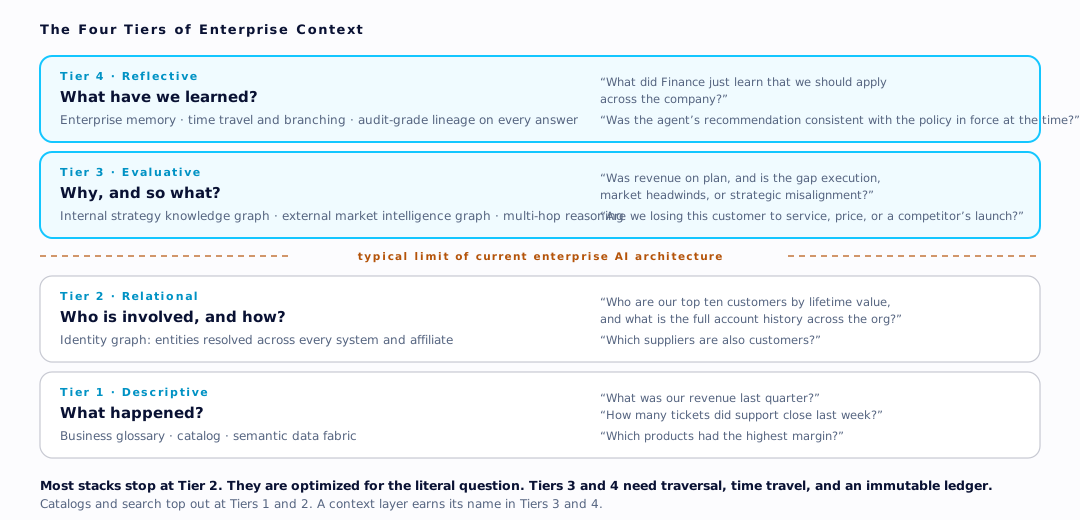
Most enterprise AI stacks stop at Tier 2. That is not a criticism of the tools; it is what a catalog plus a search index plus a vector store can reach. Tiers 3 and 4 need three things those tools do not have: traversal over typed relationships, the ability to query any past state, and a record of decisions as data. That is why the tier line is where a context layer earns its name.
How is a context layer different from a semantic layer, a knowledge graph, a catalog, or a vector database?
A context layer holds the facts, not descriptions of where the facts live. A catalog describes your data; a context layer answers with it. The other categories are either components of a context layer or techniques that run on top of one.
Two of these deserve a longer note.
The semantic layer is where enterprise context starts. If you already run one for BI, keep it; add the entity and ontology layer on top and let it govern agents as well as dashboards. We covered the build in How to Build a Semantic Layer for Enterprise AI and the comparison on the semantic layer solution page.
The context graph is the substrate, and the term deserves its credit. Jessica Talisman’s work on procedural knowledge management defined the concept before the name caught on: a knowledge graph that also records decision reasoning, the why and not just the what, with provenance and temporal validity underneath. She has written about the origin publicly, and her sharper point is one we agree with: context graphs are not a new invention. Verdantix called the step from knowledge graph to context graph incremental rather than transformational. Forrester called it a convergence, not an invention. Gartner added context graphs to several of its 2026 Hype Cycles at the Innovation Trigger, as Atlan’s review of the cycles reports, and describes them as augmenting knowledge graphs rather than replacing them. That is exactly the relationship: the context graph is a knowledge graph with provenance, time, and decisions built in, and the context layer is the architecture built on it.
How does a context layer produce answers you can trust?
A context layer produces trustworthy answers by never letting the model produce the fact. The model interprets the question against the ontology and writes a query. The graph produces the rows. The answer comes back with citations to the facts it used and the snapshot it read.
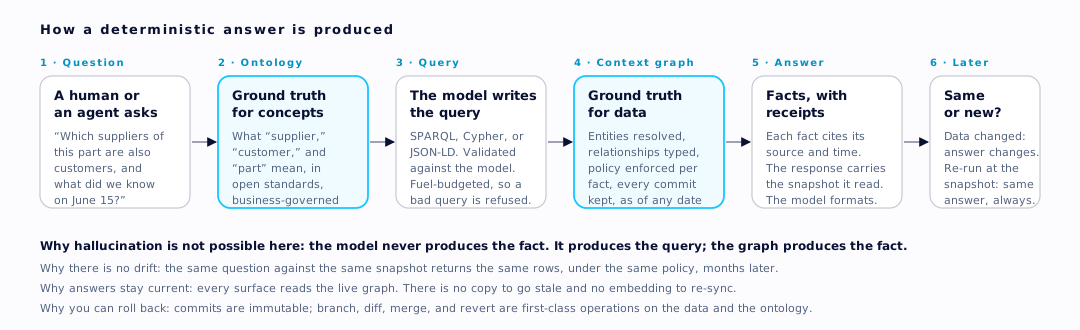
Four properties follow from that design:
- No hallucinated facts. If the graph does not contain the answer, the answer is “not found,” not a plausible guess. Queries are validated against the model and bounded before they run.
- No drift. Every response carries the snapshot it read. Re-run the same query at that snapshot and the same rows come back, under the same access policy, months later. That is how an auditor sees exactly what an agent saw.
- Always current. Every interface reads the live graph. There is no nightly copy to go stale and no embedding store to re-sync, so when the data changes, the answer changes.
- Reversible. Nothing is updated in place. Time travel is a query selector, history is a built-in diff, and branch, merge, and revert are first-class operations on the data and the ontology.
The accuracy consequence is measurable. In Fluree’s April 2024 study, GraphRAG for GenAI Accuracy, retrieval accuracy rose from roughly 20 percent zero-shot on raw relational data to 60 to 65 percent on a semantically modeled knowledge graph before any tuning, and to 95 percent or better once independently governed graphs were joined at query time. The model sets the floor. The graph sets the ceiling.
How do you add a context layer without ripping out your stack?
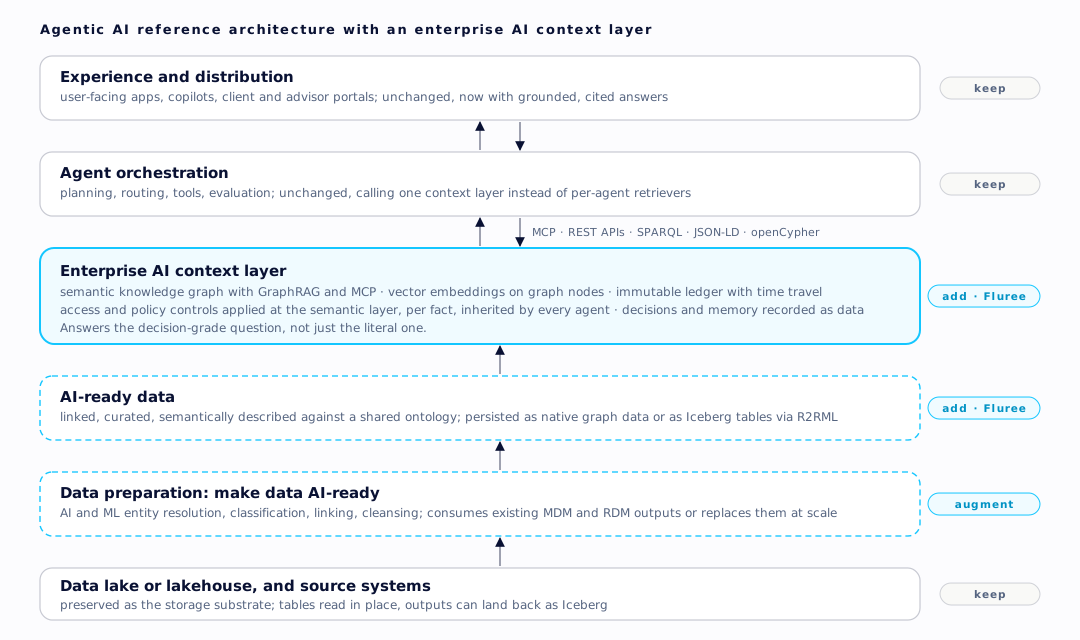
You add a context layer by keeping, absorbing, and elevating what you already run. The experience tier, the agent frameworks, and the lakehouse stay. The standalone vector store gets absorbed into the graph. Mastering and ETL get augmented. Identity and governance get elevated from raw tables to the semantic layer, where meaning lives.
Two design decisions matter more than the rest.
Where controls belong. Controls at the raw data layer (row and file permissions in the lakehouse) are necessary but blind to meaning: a masked column does not protect a derived insight. Controls inside the agent (prompt guardrails and retrieval filters) are necessary but inconsistent across teams, brittle against prompt injection, and hard to audit at multi-agent scale. Controls at the semantic layer, applied to entities, relationships, and claims in the graph, give you one place to enforce who can see what, with versioned proof, that every agent inherits automatically. Govern meaning, not just bytes and prompts. Our AI agent governance page covers the mechanics.
Where the layer sits relative to the platform. A context layer is additive to a Databricks or Snowflake deployment, not competitive with it. The platform keeps storage, compute, pipelines, machine learning, BI, and table-level governance. The context layer reads lakehouse tables in place through open formats, adds resolved entities, ontology, per-fact policy, history, and memory, and serves every agent and application the same governed answers. Nothing moves out of the platform.
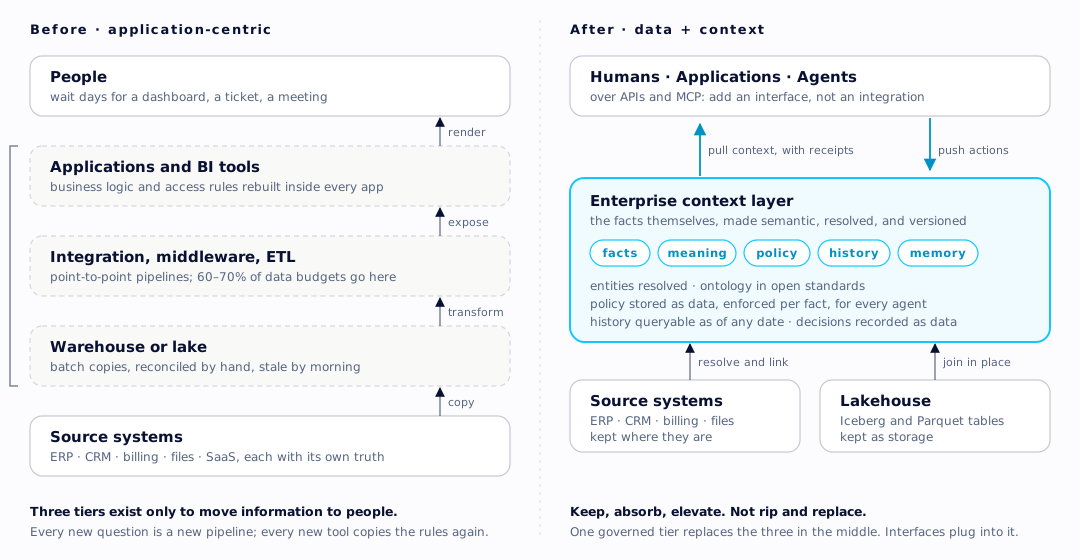
A practical build sequence, in the order we run it:
- Model. Start with the vocabulary. A governed ontology in open standards, owned by business users, is the durable asset that outlives every model and application. Reuse an upper ontology where one fits your domain, and treat changes to it as a release process rather than an admin task. If you are deciding between one enterprise ontology and one per use case, our guide to what survives production agents covers the six tests to run first.
- Map. Resolve structured data into golden records with full lineage (the entity resolution guide covers how), and turn documents, audio, and video into facts against the same vocabulary. Read lakehouse tables in place rather than copying them.
- Connect. Land everything in a knowledge graph database that keeps every commit, enforces policy per fact, and answers as of any date. That is what FlureeDB is built for.
- Activate. Expose the graph to agents over MCP and standard APIs, with memory in the same graph, and start with one decision-grade question that no current system can answer. Most teams have that first governed use case live in four to eight weeks.
If you want to see the pattern before committing to it, the demo kits are loadable data models with real public corpora and competency questions with expected answers, and a free workspace on Fluree AI takes minutes to set up.
How do you measure a context layer?
Measure a context layer on time, cost, and accuracy, because those are the three things a governed context tier changes.
- Time. A Global 500 consumer goods company unified product data from five sources at 97.5 percent accuracy in three weeks, after discovering that 48 percent of its uniquely identified product records were duplicates. A pharmaceutical company with more than two billion dollars in revenue took new analytics use cases from nine months to three weeks.
- Cost. Token prices fell roughly 99.7 percent while enterprise AI bills tripled, because architectures that re-read the transcript on every step pay a tax that compounds. In The Tokenomics of Enterprise AI, a modeled five-year ramp from 50 to 500 seats uses about 22 times fewer tokens per answer and costs 77 percent less per user when agents work from a governed graph with memory. Those are modeled economics, and the model is published.
- Accuracy. The April 2024 study above, plus the production evidence: a global financial services firm indexes more than 500,000 research documents with no manual tagging and grew its knowledge base tenfold; a government environmental department unified six million species records spanning thirty years into one graph serving more than sixty applications.
The economic argument underneath all three is the same one we made in Why AI Needs a Knowledge Graph: the integration cost of enterprise AI is unavoidable, and a context layer is the only architecture where you pay it once. The first use case pays for the ontology and the resolved data. The second is cheaper. The tenth is dramatically so.
Where does Fluree fit?
Fluree builds the enterprise AI context layer. FlureeDB is the verifiable knowledge graph database at the core: RDF and JSON-LD with complete history, per-fact policy, git-like branching, full-text and vector search in the engine, and an MCP server in the binary. Fluree AI runs it as a hosted, serverless platform that connects your sources, resolves entities, extracts facts from documents, governs the vocabulary, and serves agents, memory, and analytics from one graph. The same foundation runs in your own cloud, on-premises, or air-gapped.
Gartner’s Emerging Tech Impact Radar for Generative AI, published in August 2026, names AI context platforms as an enabling technology for autonomous and multiagent systems, and describes the category as software that constructs, governs, and delivers semantically organized knowledge to AI agents, as Atlan summarizes it. That is the category description we recognize ourselves in, with one addition that runs through this whole guide: the context has to be the data itself, governed, versioned, and provable, not a description of where the data lives.
If you are evaluating a context layer, talk to us. Bring one decision-grade question your current stack cannot answer, and we will show you what it takes to answer it with receipts.
Frequently Asked Questions
Stay in the loop
Weekly insights on enterprise AI, knowledge graphs, and data intelligence.