Context Layer vs Data Catalog, Knowledge Graph, and RAG

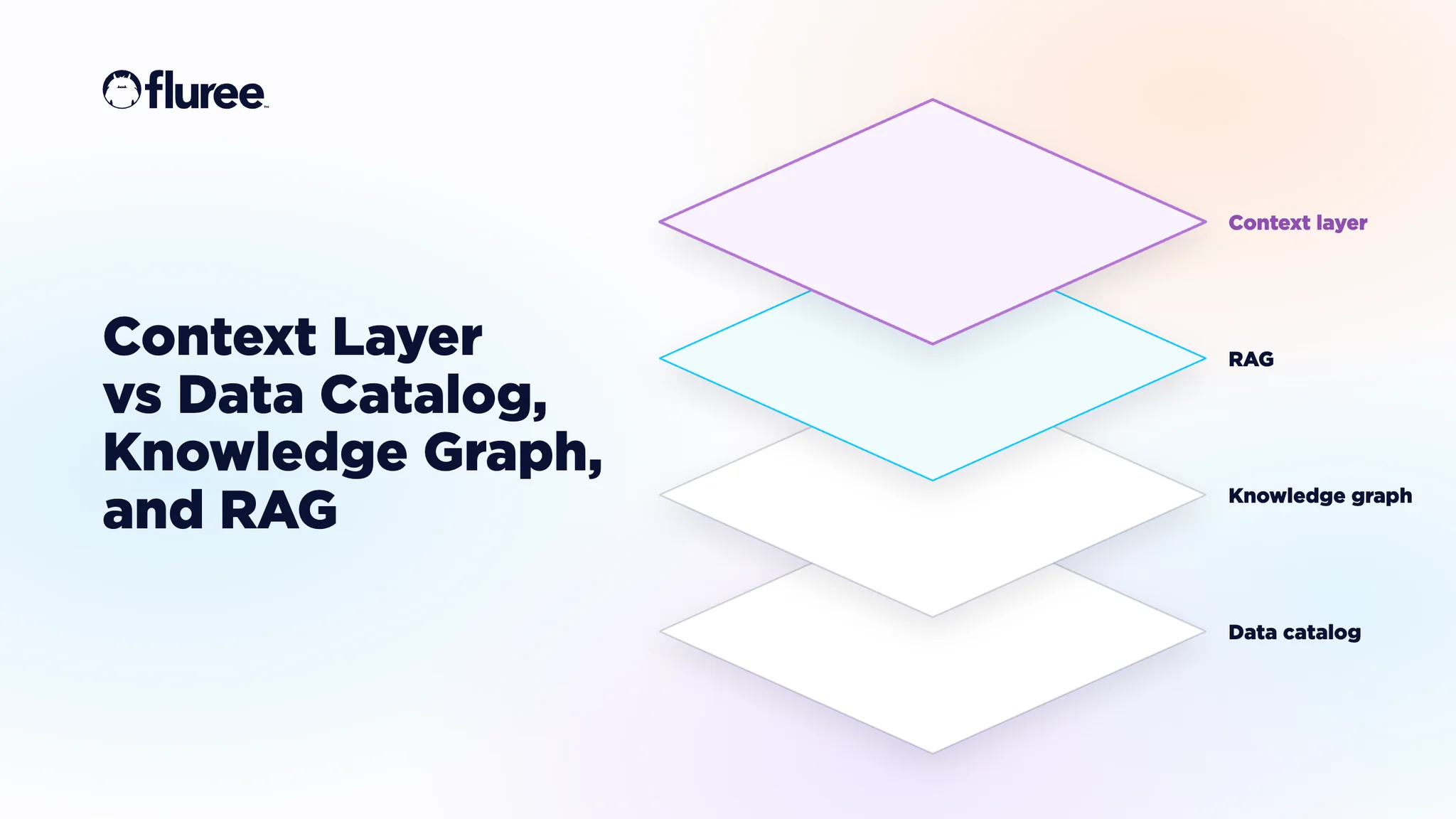
A context layer gives AI agents governed facts they can answer from. A data catalog describes your data, a knowledge graph stores connected facts, and RAG retrieves passages for a model to read. A context layer brings facts, meaning, policy, and history together in one place, and it can use a graph and retrieval to do that.
How do they compare?
What is the difference between a context layer and a data catalog?
A catalog describes your data. A context layer answers with it. A catalog tells a person or agent that a customer table exists, who owns it, and where it came from. It doesn’t resolve that customer across your CRM and billing system, and it doesn’t decide which facts a given agent may see.
Choose a catalog when the problem is discovery and stewardship. Choose a context layer when agents need to act on the answer.
Fluree is the complete context layer: meaning, entities, policy, lineage and time in one system. Already run a catalog? Fluree reads from it. You don’t need one to start.
What is the difference between a context layer and a knowledge graph?
A knowledge graph is a data structure. A context layer is a governed system built around one. The graph connects entities and relationships, which is what makes multi-hop questions possible. On its own, a graph database doesn’t necessarily resolve entities, version your vocabulary, or apply the same policy to people and agents.
A context graph, a term credited to Jessica Talisman’s work on procedural knowledge, goes further by recording decisions and when facts were true. For more, see why AI needs a knowledge graph and our knowledge graph buyer’s guide.
What is the difference between a context layer and RAG?
RAG finds relevant text. A context layer decides what’s true and who may see it. Vector RAG works well for questions a single passage can answer. It struggles when an answer depends on joining facts across systems, because similar text isn’t the same as a connected fact.
The evidence is in the data model. In Fluree’s 2024 study, GraphRAG for GenAI Accuracy, answers over raw relational tables scored 8–15% zero-shot, while a governed knowledge graph reached 95%+ once enriched and joined. That’s our own study, so read the method. You don’t have to give up RAG, because retrieval can run over the context layer. See GraphRAG vs vector RAG.
Which one do you need?
- People can’t find or trust data: start with a catalog or the governance you already own.
- Questions span several systems: you need a knowledge graph underneath.
- Answers come from documents: RAG helps, and it gets better over governed facts.
- Agents answer or act in production: you need a context layer, because someone will ask what the agent saw and why.
Ready to go further? Read how to build a context layer for AI, compare context layer platforms, or see context layer vs semantic layer. To test one on your own data, talk to us.
Frequently Asked Questions
Stay in the loop
Weekly insights on enterprise AI, knowledge graphs, and data intelligence.