What Is a Golden Record? Golden Records in Master Data Management

A golden record is the single, trusted version of a business entity, such as a customer, product, or supplier, built by matching and merging every source record that describes it and choosing the best value for each field. It is the output of master data management (MDM). A good golden record also keeps, for each field, which source the value came from and why it won.
Fluree builds golden records as part of a governed knowledge graph: resolved from your sources where they live, with the source, timestamp, and confidence of every field, and ready for AI agents to query. No separate 18-month MDM project, and no requirement to replace the MDM you have.
Golden record versus golden source, system of record, and more
The vocabulary around master data is used loosely, and vendors often treat these terms as synonyms. In practice they name different things.
The short version: a system of record is where data is made, a golden source is where a kind of data is trusted, and a golden record is what you get when you reconcile several sources into one entity. A golden record is not a copy of any one source; as Dun & Bradstreet puts it, it is reconciled from several and changes as they do.
Single customer view: where the term came from
“Single customer view” started as a regulation, not a marketing phrase. In 2009 the UK Financial Services Authority required deposit takers to be able to give the Financial Services Compensation Scheme a single, consistent view of each eligible depositor’s protected deposits within 72 hours of a request. The rule took effect on December 31, 2010, so that savers could be paid quickly if a bank failed.
Today the requirement sits in the Prudential Regulation Authority’s Rulebook, and the deadline is 24 hours. (Some sources date the 24-hour rule to 2025; the Rulebook already said 24 hours in 2021.) When the protection limit rose to £120,000 on December 1, 2025, banks had to update their single customer view systems to match.
A regulatory single customer view is a golden record with a deadline: every account a person holds, under every variation of their name and address, resolved into one depositor and totaled correctly.
Anatomy of a golden record
A useful golden record has four parts:
- A stable identifier for the entity, which never changes even when its attributes do.
- The surviving attributes: one chosen value for each field.
- Cross-references to the record ID in every contributing source, so systems can find their own version and changes can flow both ways.
- Provenance for each field: which source supplied the value, when it was last updated, which rule chose it, and how confident the match was.
Fluree stores all four on every golden record, and adds a fifth: the relationships. Because the golden record is a node in a knowledge graph, Acme Corporation is connected to its contracts, orders, contacts, and subsidiaries, not just described by its fields.
A worked example
Three systems hold a record for the same company:
After matching and survivorship, the golden record reads:
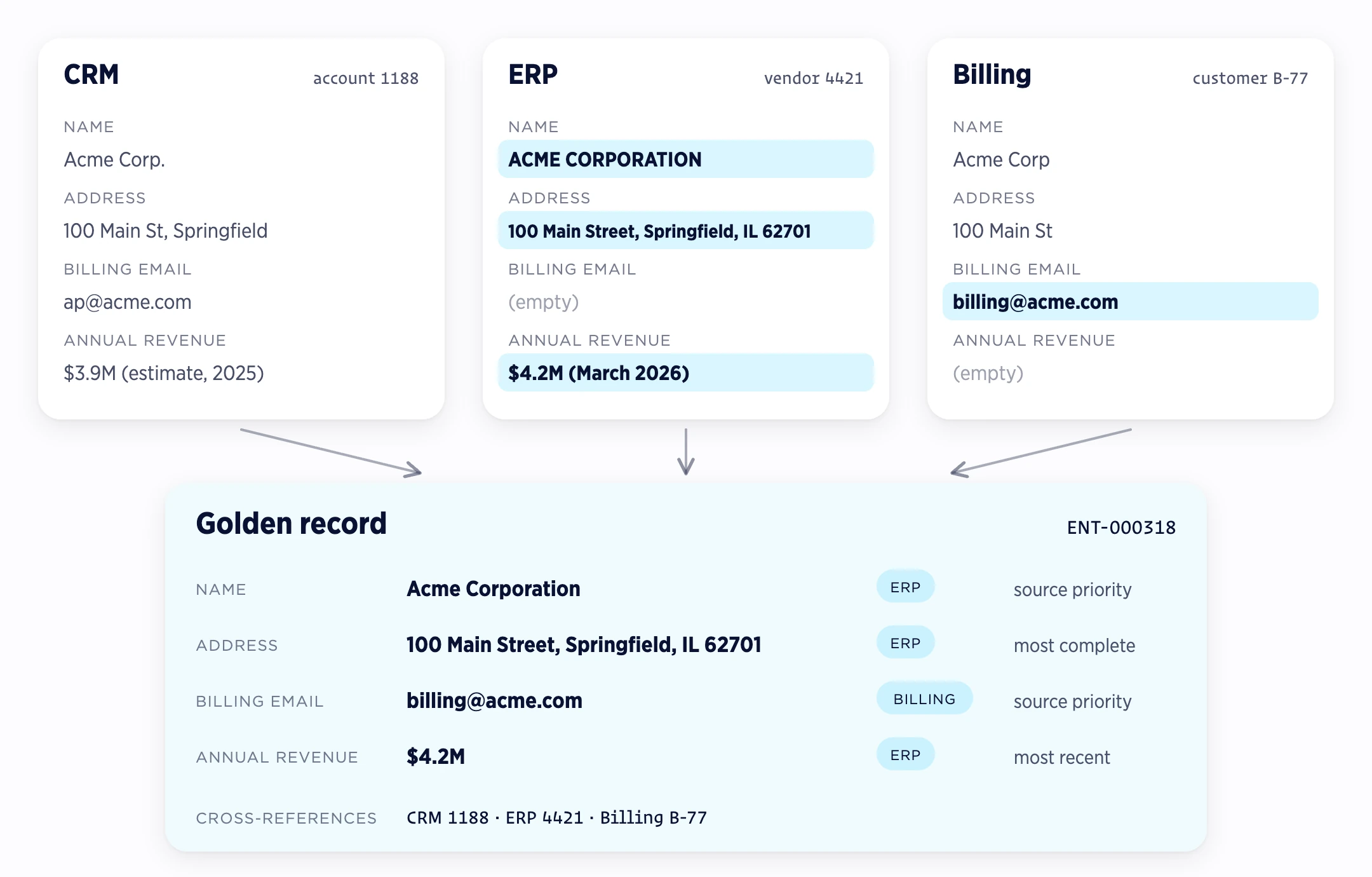
Field-level survivorship. Each field of the golden record comes from a different source, chosen by a rule, and keeps its provenance.
No single source was right about everything. That is the point of a golden record: the best value for each field, with a record of why.
How a golden record is built
- Connect and profile every source that holds the entity, and measure what is there: fill rates, formats, obvious duplicates.
- Standardize names, addresses, codes, and units so equal values look equal.
- Match the records that describe the same entity, within and across sources. This is entity resolution.
- Merge each group of matched records into one entity. Most platforms merge automatically above a confidence threshold and send the rest to data stewards, as Informatica describes.
- Apply survivorship rules to choose each field’s value.
- Steward the exceptions: people review uncertain matches and conflicting values, and their decisions train the rules.
- Publish the golden record to the systems, reports, and applications that use it.
- Keep it current. Sources keep changing, so matching and survivorship have to run again as records are added and updated.
Survivorship rules explained
Survivorship rules decide which value wins when sources disagree. The common types, as documented by IBM, Oracle, Profisee, and Semarchy:
Two design choices matter more than the rule types:
- Field level or record level. Record-level survivorship picks one source’s whole record. Field-level survivorship picks per field, which is what the worked example above does. Field-level gives better golden records and needs provenance per field to stay explainable.
- Order of operations. Platforms differ on tie-breakers and on whether duplicates within a source are removed before survivorship runs. Informatica, for example, removes duplicates first (documentation). Write the order down; there is no industry standard.
MDM implementation styles: where the golden record lives
A 2015 Gartner Consulting presentation lists four MDM implementation styles, which vendors still use, with variations. Each puts the golden record in a different place (Informatica’s summary):
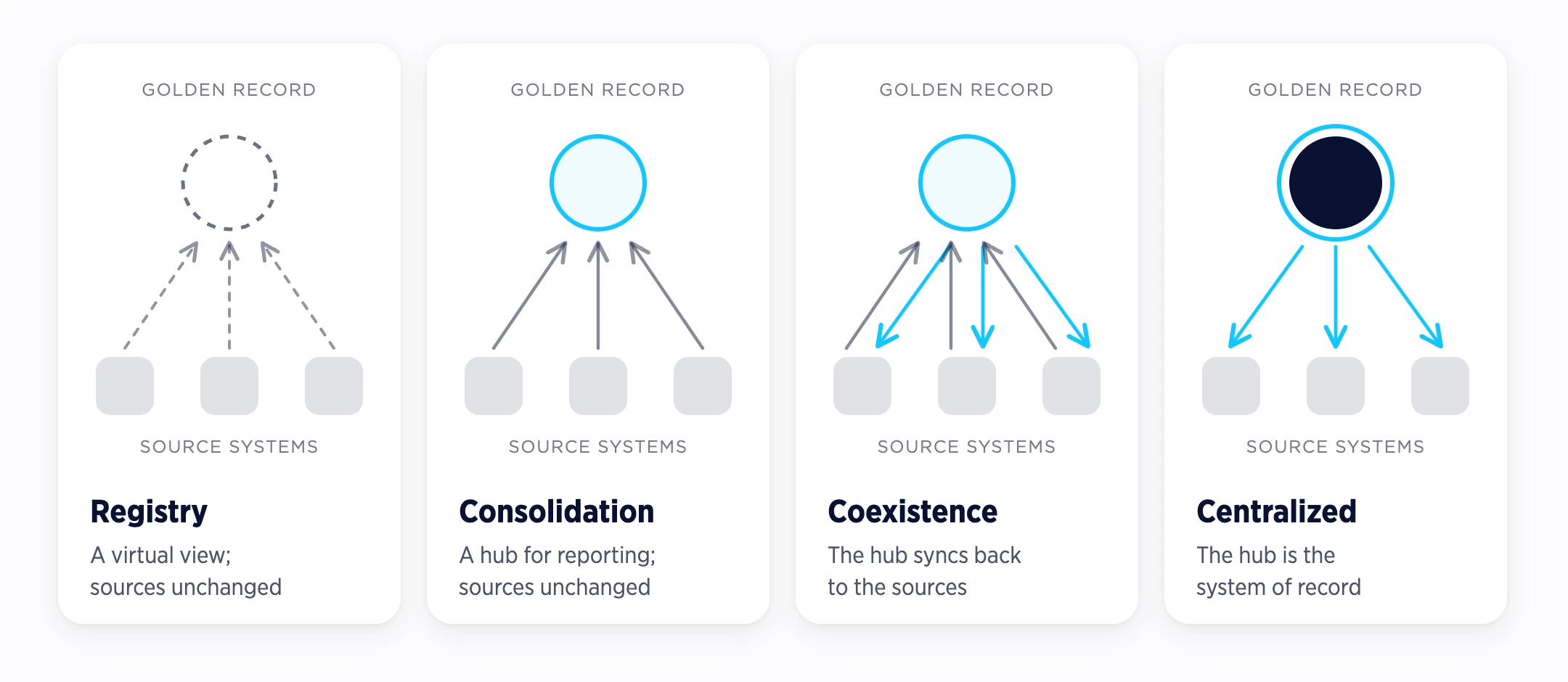
The four MDM implementation styles, by where the golden record lives and which way changes flow.
Most organizations start with consolidation, because it improves reporting without changing operational systems, and move toward coexistence where the business needs cleaner data in the systems people use every day.
Fluree takes a different route from the traditional hub. It reads sources where they live, like a registry, or builds a governed twin from a lake table that stays in sync, like consolidation, and the golden record lives as a node in a knowledge graph rather than a row in a separate hub. It can also read from an MDM hub you already run, so you do not have to replace it.
Why golden records fail, and what bad data costs
Gartner estimates that poor data quality costs organizations at least $12.9 million a year on average (2020 research). In CRM data specifically, Validity’s analysis of 264 billion records found that 81% of records in organizations without a data management tool needed improvement: duplicates, missing fields, or invalid values.
Golden record programs fail for familiar reasons:
- Rules decay. Matching and survivorship rules written for last year’s data miss this year’s formats, sources, and acquisitions.
- Batch staleness. A golden record rebuilt nightly is wrong for the rest of the day, and recency rules get fooled by load timestamps.
- The record is locked in a hub. If the systems people actually use never see the golden record, they keep creating duplicates.
- No provenance. When nobody can say why a value won, nobody trusts it, and teams go back to their own copies.
- It is treated as a project. Golden records are a running capability. The sources never stop changing.
Fluree is designed around these failure modes: matching that learns from your stewards instead of brittle rule trees, resolution as data arrives instead of nightly, golden records published to the tools and agents people already use, and provenance on every field.
Where regulation demands consolidated records
- Deposit protection. The UK single customer view rule described above requires a resolved, totaled view of each depositor within 24 hours.
- Bank risk data. The Basel Committee’s BCBS 239 principles (January 2013) require the largest banks to aggregate risk data accurately and completely across the group, which depends on consistent counterparties and entities. They have applied to global systemically important banks since January 2016.
- Know your customer. The international anti-money-laundering standard (FATF Recommendation 10) requires banks to identify customers and beneficial owners and keep that information up to date, which is hard to do with three versions of each customer.
Golden records for AI and agents
Gartner predicts that through 2026, organizations will abandon 60% of AI projects that are not supported by AI-ready data. Golden records are a large part of what “AI-ready” means for structured data, for three reasons:
- One entity, one answer. An agent that finds three customer records answers from one of them, or blends them. A golden record gives it one customer.
- Provenance makes answers explainable. If each field records its source and rule, an agent can say “annual revenue is $4.2M, from the ERP, updated March 2026,” and a reviewer can check it. See what AI grounding is.
- Relationships matter as much as records. Agents ask questions that cross entities: which suppliers of this product are at risk, which accounts share a beneficial owner. Golden records connected in a knowledge graph answer those directly.
Agents also raise the bar on freshness. A nightly batch is acceptable for a dashboard; an agent acting on a customer’s account needs the golden record as it is now. In Fluree, agents query golden records directly through MCP or GraphRAG, under the same access policy as people, so an agent sees the current record and only the fields its user may see.
Tools that build golden records
Fluree builds golden records inside a governed knowledge graph, with field-level provenance and policy, ready for AI agents (see how Fluree builds golden records below). Traditional MDM platforms, listed alphabetically:
- Ataccama ONE combines data quality, governance, and MDM in one platform.
- Informatica MDM is a multidomain MDM; Salesforce completed its acquisition of Informatica in November 2025.
- Profisee is a multidomain MDM platform.
- Reltio is a cloud-native MDM platform; SAP completed its acquisition of Reltio in May 2026.
- SAP Master Data Governance is SAP’s MDM application for SAP-centered landscapes.
- Semarchy offers configurable match, merge, and survivorship in its data platform.
- Stibo Systems offers multidomain, product, and customer MDM.
- Tamr positions itself as AI-native MDM, from research at MIT.
For a comparison of entity resolution tools with prices, see our entity resolution software guide.
How Fluree builds golden records
Fluree AI Resolve creates golden records from the data you already have:
- Connect your systems (CRM, ERP, billing, support, warehouse, and SaaS tools), reading data where it lives.
- Resolve entities with semantic matching, address normalization, and relationship analysis. Every match carries a confidence score, and ambiguous ones go to a data steward.
- Assemble the golden record as a node in the knowledge graph, with survivorship you configure (newest wins, most complete wins, or source priority) and the source, timestamp, and confidence on every field.
- Keep it current. Sources are read in place, and lake tables copied into Fluree refresh automatically, so the golden record changes when the sources do.
- Put it to work. People query it in the tools they use; agents query it through MCP or GraphRAG, under per-fact access policy.
Results from production:
- A community bank unified more than 330,000 customers across 113 branches into household-level golden records with full lineage.
- A global consumer goods company found that 48% of its product records were duplicates across five sources and reached 97.5% accuracy, in production in three weeks.
Documents count too: Fluree AI Extract links what contracts, emails, and reports say to the same golden records, with the excerpt behind each fact.
Frequently Asked Questions
Stay in the loop
Weekly insights on enterprise AI, knowledge graphs, and data intelligence.