What Is Entity Resolution? How It Works, From Record Linkage to LLMs

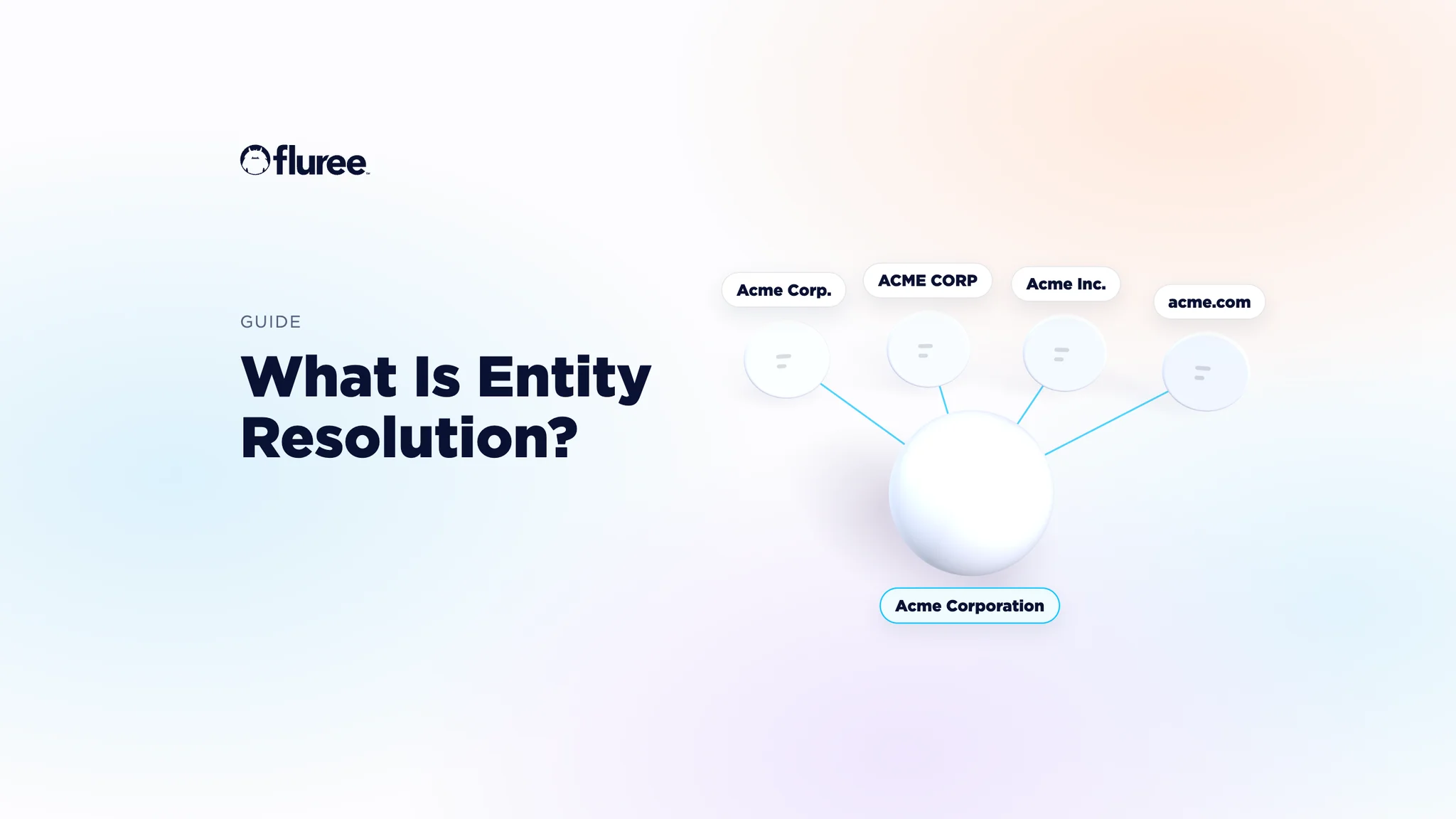
Entity resolution is the process of finding records that refer to the same real-world entity, such as a person, company, product, or place, across one or more data sources, and grouping them so the entity is represented once. It is also called record linkage, data matching, or deduplication, depending on who is doing it and why.
A simple example: account 1188 in the CRM is “Acme Corp.” at 100 Main St. Vendor 4421 in the ERP is “ACME CORPORATION” at 100 Main Street. A billing contact lists “acme.com.” Entity resolution decides that all three are the same company, links them, and gives the company one identity that every system and every AI agent can use.
Fluree does this as data arrives: rules for exact identifiers, machine learning trained with your subject-matter experts for the rest, data stewards for the close calls, and each resolved entity stored as a node in a governed knowledge graph that AI agents can query.
Entity resolution versus related terms
The field grew up in statistics, public health, computer science, and direct marketing at the same time, so it has many names. They overlap, but they are not identical.
Entity linking is a neighbor but a different task: it connects mentions in text to records, rather than records to records. See what AI grounding is for how the two work together.
A short history: from 1946 to language models
- 1946. Halbert Dunn, chief of the US National Office of Vital Statistics, named the problem in “Record Linkage” in the American Journal of Public Health: assembling the records of each person’s life into one file.
- 1959. Howard Newcombe and colleagues linked birth and marriage records by computer in Science, and introduced the idea that agreement on a rare value (an unusual surname) says more than agreement on a common one.
- 1969. Ivan Fellegi and Alan Sunter published “A Theory for Record Linkage” in the Journal of the American Statistical Association, the probabilistic model most matching systems still build on.
- 2000s–2010s. Supervised machine learning and active learning (a person labels the pairs the model is least sure of) replaced hand-tuned weights.
- 2020s. Fine-tuned language models such as Ditto set the benchmarks, and since 2023 large language models have matched them with few or no training examples.
How entity resolution works, step by step
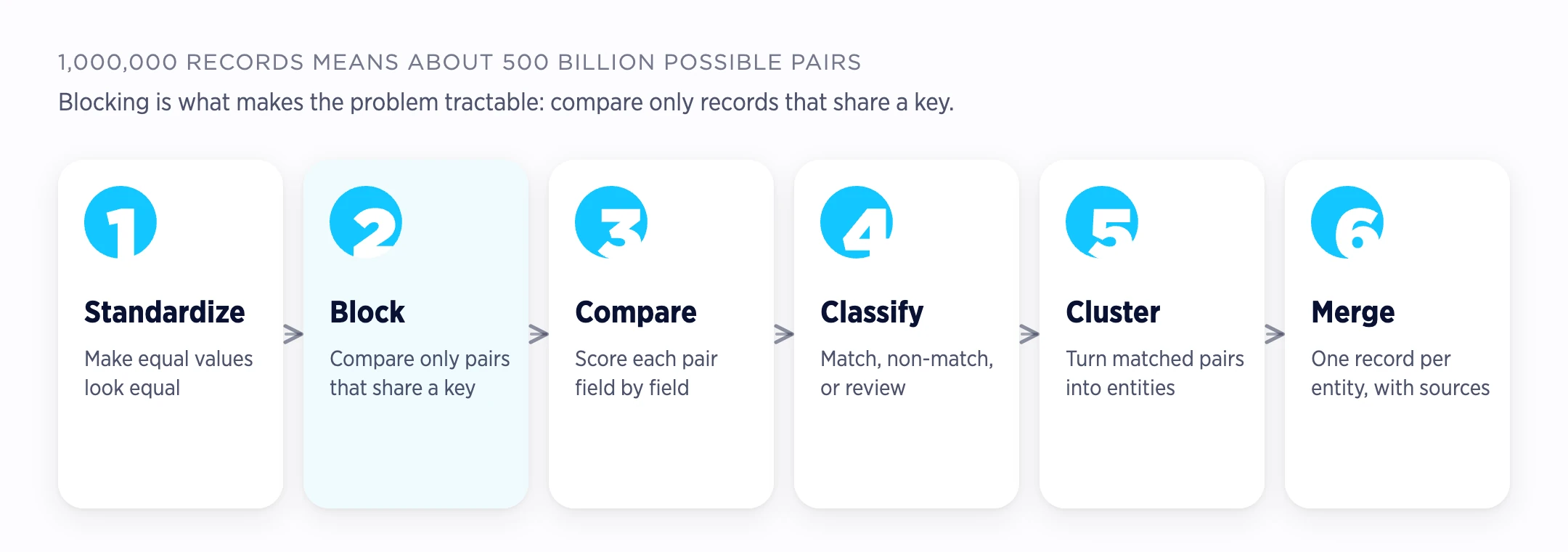
The six steps of entity resolution. Blocking is what makes the problem tractable: without it, one million records means about 500 billion comparisons.
1. Standardize
Clean the values so that equal things look equal: consistent case, expanded abbreviations (“St.” to “Street”), parsed names and addresses, one form for each country (“USA,” “U.S.,” and “United States”). Every serious guide starts here because every later step depends on it.
2. Block
Comparing every record with every other grows with the square of the data. One million records produce about 500 billion pairs (n × (n − 1) ÷ 2). Blocking compares only records that share a key, such as the same postal code or the first letters of a name. The risk is that true matches with different keys are never compared, so production systems run several blocking passes with different keys.
3. Compare
For each candidate pair, compare field by field and turn each comparison into a score:
- Edit distance (Levenshtein) counts the character changes between two strings: “Jonathon” and “Jonathan” differ by one.
- Jaro–Winkler weights agreement at the start of a string, which suits names.
- Token measures compare words regardless of order, so “Corporation Acme” still matches “Acme Corporation.”
- Phonetic codes (Soundex, Double Metaphone) match names that sound alike but are spelled differently.
- Exact identifiers (tax ID, email, account number) are compared exactly, and are the strongest evidence when present.
4. Classify
Decide, for each pair, match or non-match. This is where the approaches differ, covered in the next section. Most systems keep a third outcome, review, for pairs that are too close to call.
5. Cluster
Pairwise decisions have to become entities. The simplest method treats matches as links and takes the connected groups. It is fast and easy to explain, but one wrong link can join two groups that should be separate: if A matches B and B wrongly matches C, A and C end up as one entity. Better systems check the consistency of a whole cluster, not only its pairs.
6. Merge
Build one record per entity. Survivorship rules choose which value wins for each field: the most trusted source, the most recent value, or the most complete. Good systems keep every source value and the reason it won, so the merge can be explained and undone. This output is the golden record.
Matching approaches: rules, probability, machine learning, and LLMs
Most production systems are hybrids: deterministic rules for exact identifiers, a probabilistic or learned model for the rest, and people for the review band.
The Fellegi–Sunter model, simply
For each field, ask two questions:
- m-probability: if two records really are the same entity, how often does this field agree? (For birth date, very often.)
- u-probability: if they are different entities, how often does it agree by chance? (For birth date, rarely; for gender, half the time.)
The ratio of the two says how much an agreement is worth. A matching birth date is strong evidence; a matching gender is weak. The model adds up the evidence across fields into one score, then applies two thresholds: above the upper one is a link, below the lower one is not, and everything between goes to a person. Fellegi and Sunter showed how to set the thresholds to keep that manual-review band as small as possible for the error rates you accept.
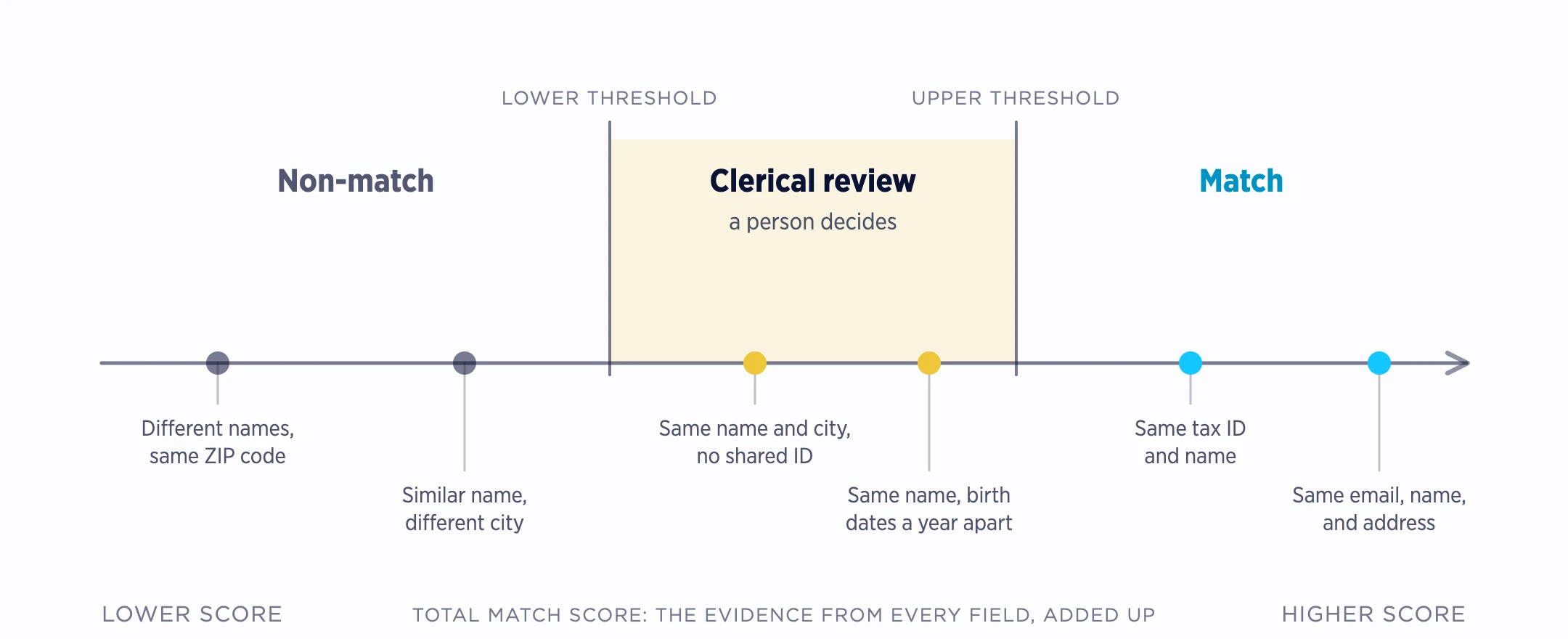
Fellegi–Sunter in one picture: every pair gets a score, two thresholds split the scores into non-match, review, and match. Tuning is choosing where the thresholds sit.
What large language models change
The clearest public evidence is Peeters, Steiner, and Bizer (EDBT 2025), who tested language models against fine-tuned matchers on six standard benchmarks. GPT-4, with no training examples, scored F1 of 89.6 on the WDC Products benchmark against 84.9 for the fine-tuned Ditto, and 95.8 against 91.3 on Abt-Buy. It lost on Amazon-Google (76.4 against 80.1) and DBLP-Scholar (89.8 against 94.3). The more telling result: fine-tuned matchers trained on one product dataset fell to about 49–56 F1 on another, while the language models held up.
The practical reading is that language models are strong judges of hard pairs, but far too slow and costly to run on billions of comparisons. Put them after blocking, on the pairs that rules and scores cannot settle, and log their explanations for review.
How to measure entity resolution quality
- Precision: of the pairs the system matched, how many are true matches.
- Recall: of the true matches, how many the system found.
- F1: the harmonic mean of the two.
Pairwise measures overweight large clusters, so teams also use cluster-level measures such as B-cubed (Bagga and Baldwin, 1998), which scores each record’s cluster rather than each pair.
The two kinds of error are not equally costly:
- A false merge blends two real entities: a father and son with the same name, or two companies that share an address. It exposes one person’s data to another and is hard to undo once downstream systems have used it.
- A false split leaves one entity in pieces. Risk, spend, and history are undercounted, but nothing is wrongly shared.
Most teams tune for precision on anything that drives automated action and accept some false splits for steward review. Fluree works the same way: high-confidence matches merge automatically, ambiguous ones go to a data steward, and every match records its confidence score so the threshold can be tuned per use case. Public benchmarks such as WDC Products (11,715 product offers describing 2,162 entities) show why testing on your own data matters: state-of-the-art systems ranged from 0.64 to 0.89 F1 depending on the variant, and all of them struggled with entities they had not seen in training.
Entity resolution, master data management, and golden records
The three terms describe a process, a program, and a result.
Entity resolution is the engine inside MDM. Many teams now start with entity resolution and add the program around it, rather than the reverse. For the output side, see what a golden record is and how survivorship works.
Entity resolution for knowledge graphs and AI
A knowledge graph with unresolved entities is a graph of duplicates. Facts about one customer sit on three nodes, relationships split across them, and every count, path, and risk score is wrong. Researchers studying graph-based retrieval report the same problem in automatically built graphs: duplicate and alias nodes (“Dr. Watson” and “Watson”) that scatter facts the model needs (arXiv 2510.14271).
For AI agents the effect is worse than for dashboards, because an agent answers confidently from whichever node it finds. Ask about Acme’s open orders and you get one node’s answer, not the company’s. Fluree’s own 2024 GraphRAG accuracy study found that questions over raw relational data scored 8–15% zero-shot, while governed knowledge graphs started at 60–65% and passed 95% once enriched; resolved entities are part of that enrichment.
Graph-based entity resolution
Graphs also help do entity resolution, because shared neighbors are evidence: two customer records that share a phone number, a device, and a shipping address are probably one customer. Fluree uses those relationships alongside names and addresses when it matches, which is how “Acme Corp” at 100 Main St and “Acme Corporation” at 100 Main Street resolve even when no ID is shared. Neo4j’s Graph Data Science library is a common example. Its team describes using weakly connected components to group records, node similarity to score pairs, Node2Vec embeddings, and link prediction, and an example in which Meredith Corporation resolved 14 billion anonymous user records into 163 million profiles.
Batch, real-time, and incremental
- Batch resolution reprocesses everything on a schedule. Simple, but results are only as fresh as the last run.
- Real-time resolution resolves each record as it arrives, which fraud checks and customer service need.
- Incremental resolution updates only the entities a change touches, and revisits earlier decisions when new evidence arrives.
Agents that act on current data need real-time or incremental resolution; a nightly batch means an agent can act on yesterday’s duplicates. Fluree resolves records as they are ingested and reads sources where they live, so resolved entities stay in step with the systems that feed them.
Where entity resolution is used
- Customer 360 and marketing: one profile per customer across channels, devices, and systems.
- Financial crime, KYC, and anti-money laundering: linking accounts, people, and companies that share phones, addresses, or directors, to spot rings and screen against sanctions lists.
- Healthcare: matching patients across providers. Pew reported in 2018 that match rates between organizations could be as low as 50%, even when they used the same records vendor.
- Product catalogs: one product per SKU across suppliers and channels. In a Fluree customer’s catalog, 48% of product records turned out to be duplicates.
- Banking: households and relationships across branches and systems, as in a community bank that unified 330,000 customers.
- Government statistics: the UK Office for National Statistics used the open-source Splink library to link 2021 Census data.
Entity resolution software: the landscape
Listed by type, unranked:
- Engines and SDKs: Senzing embeds real-time entity resolution in other applications.
- Cloud services: AWS Entity Resolution, generally available since July 2023, offers rule-based, machine learning, and data-provider matching.
- Open-source libraries: Splink (probabilistic, from the UK Ministry of Justice’s analytical services, MIT license), Zingg (machine learning on Spark), and dedupe (active learning in Python).
- MDM platforms: Informatica, Reltio, and Tamr include entity resolution inside a master data program.
- Decision intelligence: Quantexa resolves entities for financial crime and risk work.
- Knowledge graph platforms: Fluree resolves entities during ingestion into a governed knowledge graph, with confidence scores, field-level lineage, and per-fact access policy, ready for AI agents through MCP. Neo4j’s Graph Data Science library supports graph-based matching inside a property graph.
For a comparison with prices and selection criteria, see our entity resolution software guide.
How Fluree resolves entities
Fluree treats entity resolution as part of building the knowledge graph, not as a separate project that ends in a spreadsheet.
- Connect sources where they live. CRM, ERP, billing, support, warehouse, and lake tables, read in place or copied from a lake table into a governed twin that stays in sync.
- Normalize to shared vocabularies. Names, addresses, codes, and categories are standardized against the taxonomies you maintain, so equal things compare as equal.
- Match with rules, models, and people. Deterministic rules settle exact identifiers such as tax IDs and emails. Machine learning, trained with input from your subject-matter experts, handles the messy rest. Ambiguous matches go to data stewards, and their decisions improve the model.
- Keep the evidence. Every match carries a confidence score, and every field of the resolved entity keeps its source, timestamp, and the rule that chose it.
- Publish a governed graph. Each resolved entity becomes a node connected to everything else you know about it, with access policy enforced on every fact, and agents can query it through MCP or GraphRAG.
In practice:
- A global consumer goods company found that 48% of its product records were duplicates across five sources, and reached 97.5% catalog accuracy, in production in three weeks.
- A community bank unified more than 330,000 customers, across 113 branches and three to five competing reporting systems, into household-level golden records with full lineage.
See Fluree AI Resolve for how it works on your tables, and our entity resolution software guide for how it compares.
Frequently Asked Questions
Stay in the loop
Weekly insights on enterprise AI, knowledge graphs, and data intelligence.