Why AI Needs a Knowledge Graph: Durable Data, Explicit Meaning, Consistent Answers

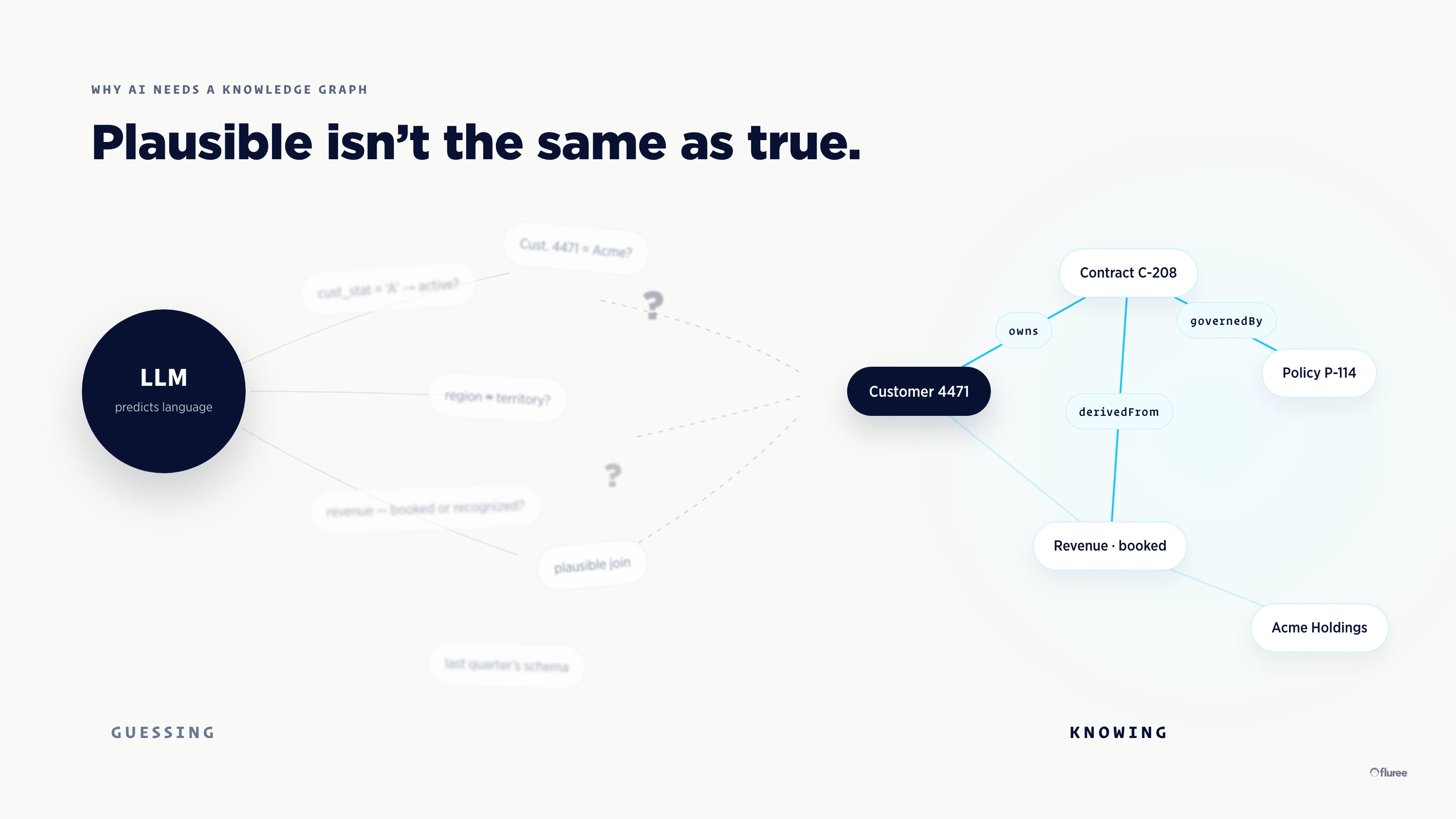
AI needs a knowledge graph because large language models generate plausible language, not verified facts. A knowledge graph supplies what the model fundamentally lacks: an explicit, machine-readable representation of your entities, relationships, and business rules that AI systems can query, cite, and trust. Without one, every AI application re-derives your organization’s meaning on every request — expensively, inconsistently, and invisibly. With one, meaning is defined once, governed centrally, and reused by every model, agent, and application that comes after.
That’s the short answer. The long answer comes down to four properties that ad-hoc AI integration cannot deliver:
- Explicit meaning — definitions live in a shared, versioned model, not in prompts and fine-tuned weights.
- A durable asset — integration work persists and compounds instead of being discarded after every query.
- Consistent answers — the same question returns the same governed, traceable answer every time.
- Cost paid once — the integration cost of enterprise AI is unavoidable; a knowledge graph is the only architecture where you pay it once instead of forever.
This guide walks through each one — and addresses the obvious counterargument: if LLMs are so good at interpreting messy data, why build structure at all?
What Is a Knowledge Graph?
A knowledge graph is a structured representation of knowledge as a network: entities (customers, products, policies, people) connected by typed, named relationships (owns, reportsTo, regulatedBy, derivedFrom). Unlike tables that store values, a knowledge graph stores meaning — each node and edge carries semantics that both humans and machines can interpret unambiguously.
Three ingredients make a knowledge graph more than just “a graph database with data in it”:
- An ontology — a formal model of what kinds of things exist in your domain and how they can relate. (Taxonomies and ontologies differ; a knowledge graph typically uses both.)
- Instance data — the actual entities and relationships, conformant to that model.
- Shared identifiers — globally unique references (typically IRIs, as in JSON-LD) so that “Customer 4471” means the same thing in every system that touches it.
The result is data that explains itself. And that property — self-describing data — turns out to be exactly what AI systems are missing.
The Core Problem: LLMs Predict Language, They Don’t Know Your Business
A large language model is a probability engine over text. It has read the public internet; it has never read your order management system, your policy hierarchy, or the three different definitions of “active customer” that Finance, Sales, and Support quietly maintain.
When you connect an LLM directly to raw enterprise sources — SQL databases, CSV exports, API payloads — you’re asking it to do two jobs at once: answer the question and reverse-engineer what your data means. It has to guess that cust_stat = 'A' means active, that region in the CRM is not the same as territory in the ERP, and that revenue in one table is booked while in another it’s recognized. Sometimes it guesses right. The problem is the word guess.
This is why enterprise AI hallucination is a data problem before it’s a model problem. Surveys consistently find the gap: 78% of businesses report they’re unprepared for generative AI due to poor data foundations. The models are ready. The data isn’t.
Gartner’s designation of knowledge graphs as a “Critical Enabler” with immediate impact on generative AI reflects the same conclusion from the analyst side: grounding is not optional, and grounding requires structure.
The four sections that follow are the argument in detail.
Reason 1: Explicit Meaning — Semantics Live in a Shared Model, Not in Prompts and Weights
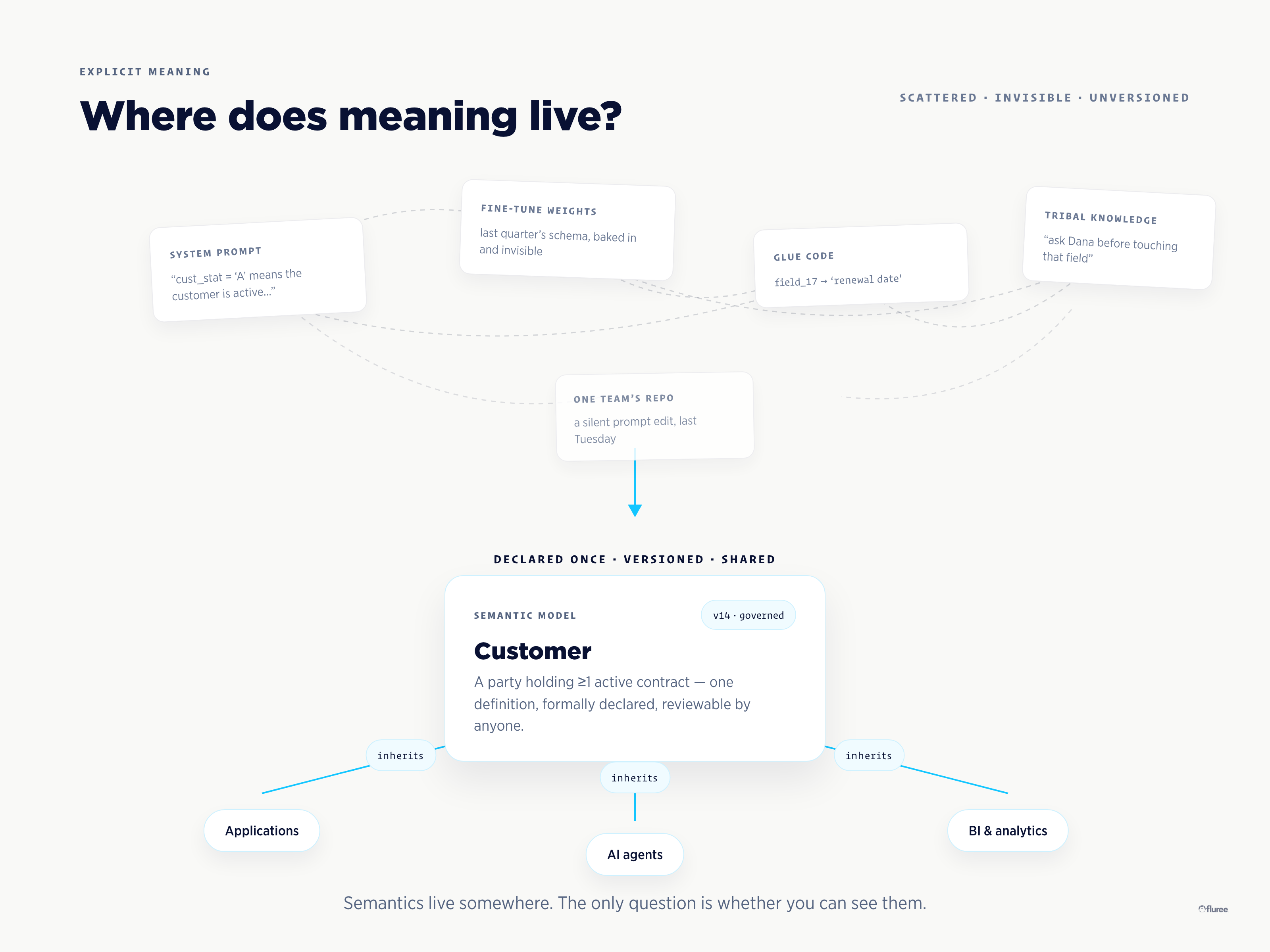
Every AI system that touches enterprise data encodes semantics somewhere. The only question is where.
In ad-hoc integration, meaning lives in fragile, invisible places: a system prompt that explains what the columns mean, a fine-tune that baked in last quarter’s schema, glue code that maps field_17 to “contract renewal date.” None of it is inspectable. None of it is shared between applications. When the schema changes or a definition is disputed, there is no single place to look — meaning is smeared across prompts, weights, and scripts.
A knowledge graph moves semantics out of the model and into the data:
- Definitions are declared, not inferred. “Active customer” is a class with formal membership criteria, not a vibe the model picked up from column names.
- Relationships are typed.
Company A — acquiredBy → Company Bcannot be misread as a partnership. The edge itself carries the meaning. - Constraints are enforceable. Shape languages like SHACL validate that data actually conforms to the model — before an AI system consumes it, not after it hallucinates around a violation.
- Meaning is versioned. When the definition of “churn” changes, that change is a governed, reviewable event in the shared model — not a silent prompt edit in one team’s repo.
The practical test is simple: when your AI gives a wrong answer, can you point to the fact or definition it got wrong? With explicit semantics, yes — and you fix it once, in one place, for every downstream consumer. With implicit semantics, the answer is “retry the prompt and hope.”
Reason 2: A Knowledge Graph Is a Durable Asset — Ad-Hoc Integration Is an Expense
Here’s the question that separates the two architectures: after your AI answers a question, what’s left behind?
With ad-hoc integration, the answer is nothing. The agent read the sources, inferred the joins, resolved the entities, produced an answer — and discarded all of it. The mappings it worked out, the entity resolutions it performed, the semantic connections it discovered: gone. The next query, even an identical one, rebuilds everything from zero. You’re renting understanding by the token, forever.
A knowledge graph inverts this. Integration work accumulates:
- Resolve “IBM,” “International Business Machines,” and “I.B.M. Corp” to one entity once, and every future query benefits.
- Map the ERP’s product hierarchy to the catalog’s taxonomy once, and every application inherits the mapping.
- Encode the compliance rule that links policies to the departments they govern once, and every agent that touches policy questions gets it for free.
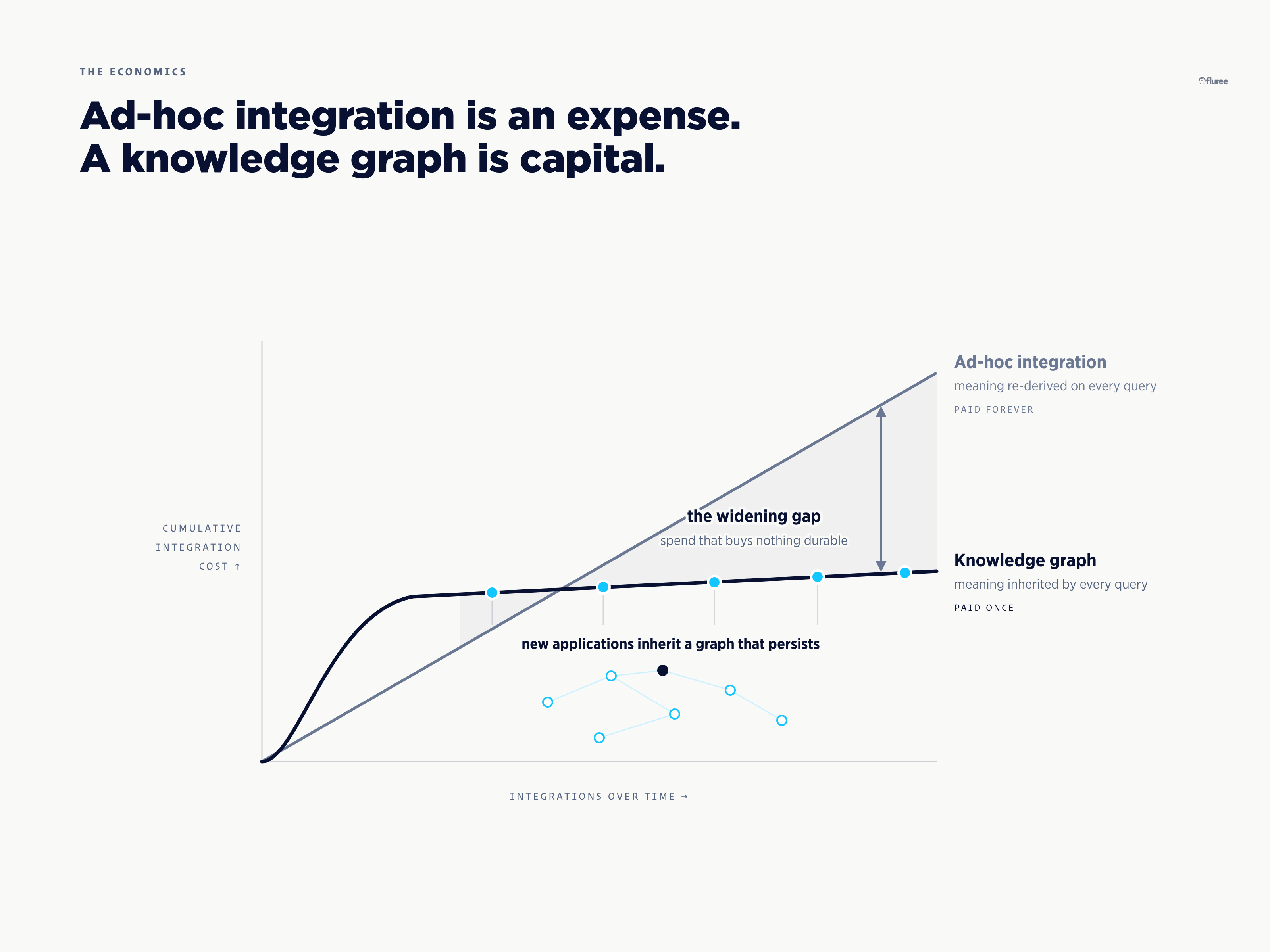
This is the difference between an expense and an asset. Ad-hoc integration is operating spend that scales linearly (or worse) with query volume. A knowledge graph is capital: each new source, definition, and resolved entity increases the value of everything already in the graph, because new nodes connect to existing ones. Organizations that treat integrated, semantically explicit data as corporate memory are building something their competitors have to rebuild on every request.
It’s also the asset that survives model churn. This year’s frontier models will be replaced; your entity graph, your ontology, and your resolved identities remain valuable through every generation of AI that consumes them. In an era where model capabilities commoditize quarterly, the durable differentiator is the data foundation only you can build — because it describes your business.
Reason 3: Consistent Answers — Same Question, Same Answer, Every Time
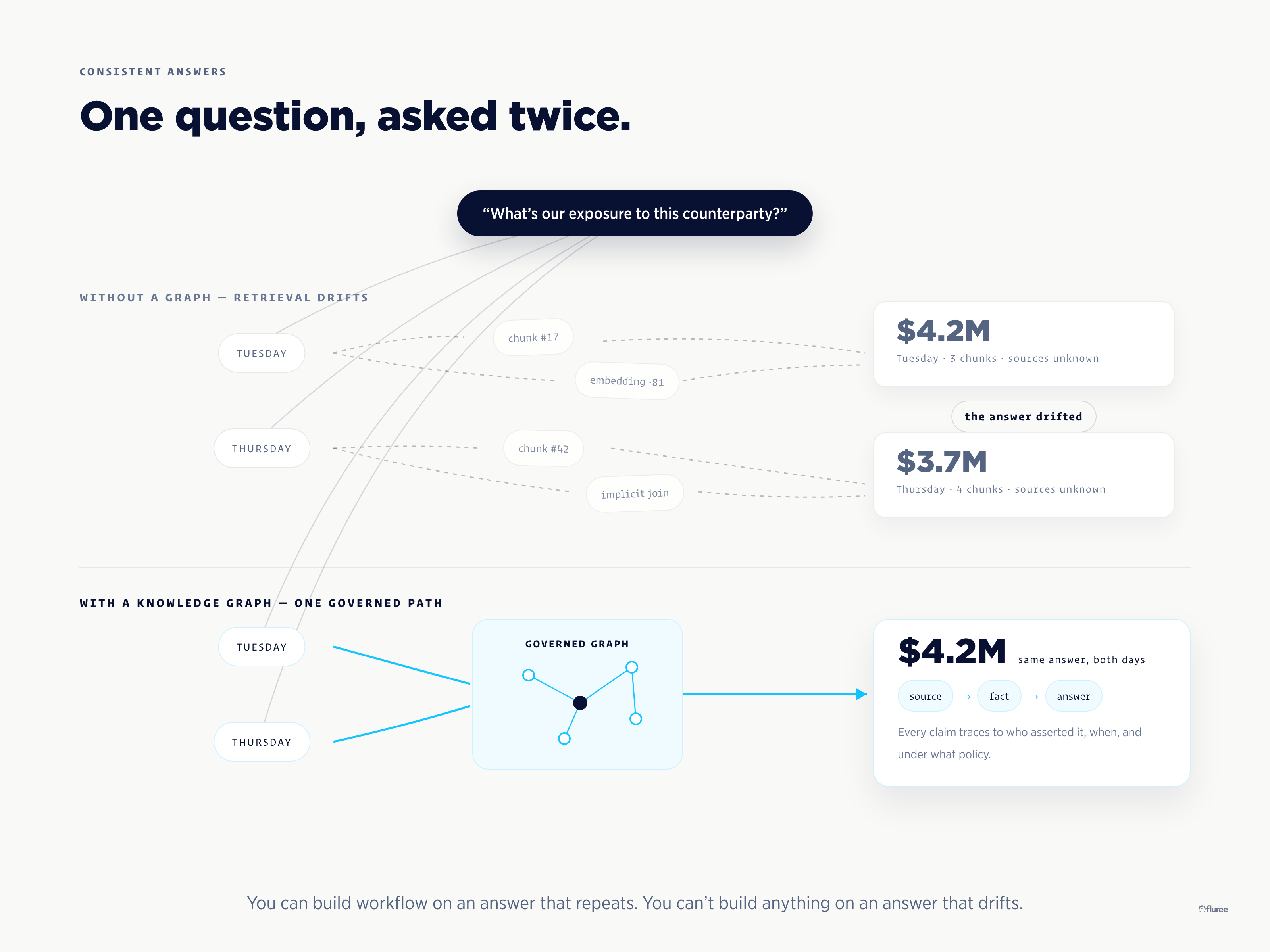
Ask an LLM-over-raw-data system the same question on Tuesday and Thursday and you can get different answers. Different chunk retrievals, different sampled reasoning paths, different implicit joins. For a consumer chatbot, that’s a quirk. For a system that answers “what’s our exposure to this counterparty?” or “which patients are on this protocol?”, it’s disqualifying.
Consistency isn’t a model property. No amount of temperature tuning makes a system deterministic when the semantic interpretation of the data is re-derived per query. Consistency comes from the layer beneath:
- One definition per concept. When “quarterly revenue” resolves to a single governed definition in the graph, every application computes it the same way. The AI isn’t choosing between three interpretations — there’s one.
- Traversal instead of similarity. Graph retrieval follows explicit edges rather than ranking text chunks by embedding proximity. GraphRAG outperforms vector-only retrieval precisely on the queries where consistency matters most — multi-hop, hierarchical, and relational questions.
- Provenance and auditability. When answers are grounded in graph facts, each claim traces to a source — who asserted it, when, and under what policy. “Why did the AI say that?” becomes a query, not a forensic investigation.
- Governance at the data layer. Access policy enforced on the data itself means two users with different entitlements get appropriately different answers — consistently — rather than whatever the prompt let slip through.
The measured accuracy gap is substantial. In Fluree’s April 2024 study, GraphRAG for GenAI Accuracy, LLMs answering over centralized relational data started near 20% zero-shot accuracy; the same questions over knowledge graphs started at 60–65% and reached 95–99% with enriched, connected graphs. And independent research consistently shows vector-only retrieval degrading sharply as questions span more entities, while graph traversal holds stable.
Consistent answers are what make AI operational rather than advisory. You can build workflow on an answer that repeats. You can’t build anything on an answer that drifts.
Reason 4: You Pay the Integration Cost Once
Reason 2 was the balance-sheet view — what you own afterward. This is the cash-flow view of the same fact, and it’s worth stating plainly: the integration cost of enterprise AI is unavoidable — the only choice is whether you pay it once or on every query.
The ad-hoc path defers the cost and then pays it perpetually:
- Per-query token spend on re-interpreting schemas and re-resolving entities
- Per-application glue code, each with its own private, drifting semantics
- Per-incident debugging when two systems disagree, with no shared model to arbitrate
- Per-model migration cost, because the semantics were entangled with a specific model’s prompts and fine-tunes
The knowledge graph path front-loads the cost and then amortizes it:
- Model the domain once; every application queries the same semantics
- Resolve entities once; every future question about them is grounded
- Govern definitions once; consistency is inherited, not re-implemented
- Swap models freely; the knowledge layer is model-agnostic
Neither path is free, and knowledge graph advocates shouldn’t pretend otherwise — ontology design, entity resolution, and source mapping are real work. But it’s work with a fundamentally different return profile: it compounds. The tenth application built on the graph costs a fraction of the first, while the tenth ad-hoc integration costs roughly the same as the first — plus the growing tax of keeping ten private semantic interpretations from contradicting each other.
Ad-Hoc AI Integration vs. Knowledge Graph: Side by Side
“Don’t LLMs Make Knowledge Graphs Obsolete?”
It’s the most common objection, and it deserves a straight answer: no — LLMs make knowledge graphs more valuable, and they also make them dramatically cheaper to build.
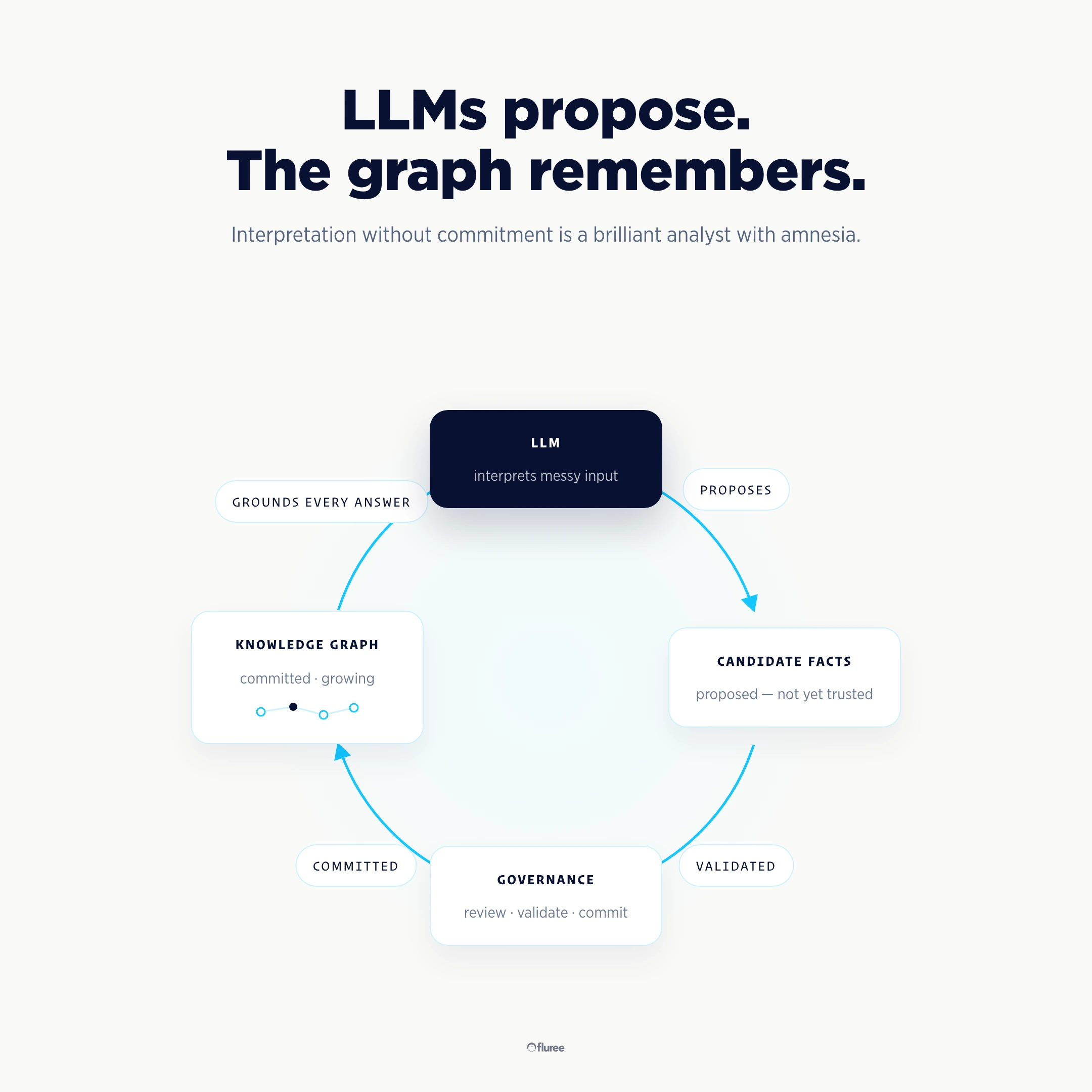
The objection assumes knowledge graphs and LLMs compete at the same job. They don’t. LLMs are superb at interpretation: reading a messy document, guessing a schema mapping, extracting candidate entities from text. Knowledge graphs are superb at commitment: recording which interpretations your organization has verified, governs, and stands behind. Interpretation without commitment gives you a brilliant analyst with amnesia. Commitment without interpretation gives you a pristine model that’s perpetually behind reality. The architecture that works uses both:
- LLMs handle the long tail. Novel questions, one-off sources, and exploratory analysis run through the model’s interpretive flexibility — no upfront modeling required.
- Proven integrations get promoted. When an interpretation shows up repeatedly and survives validation, it graduates into the governed graph: the entity resolution becomes an edge, the schema guess becomes a mapping, the extracted rule becomes an ontology axiom.
- The graph becomes the checked-in knowledge. Like code review for meaning — the LLM proposes, governance disposes, and the graph accumulates only what passed.
There’s a second half to the answer: LLMs have collapsed the historical cost of building knowledge graphs. Entity extraction, ontology drafting, and source mapping — once the multi-year, consultant-heavy bottleneck — are now substantially automatable with LLM assistance, with humans validating rather than authoring. The classic argument against knowledge graphs (“too expensive to build”) and the new argument (“LLMs make them unnecessary”) cancel each other out. The technology that supposedly obsoletes the knowledge graph is the same technology that finally makes it cheap.
Knowledge graphs aren’t what AI replaces. They’re what AI runs on.
How Knowledge Graphs Ground AI in Practice
The abstract case becomes concrete in three architectural patterns, usually adopted in this order:
GraphRAG — retrieval over relationships. Instead of retrieving text chunks by embedding similarity, GraphRAG traverses the graph to assemble precise, relationship-aware context: the entity in question, its verified connections, the policies that govern it. This is context engineering with a governed source of truth behind it. The LLM receives structured facts rather than ambiguous prose — which is much harder to hallucinate around. For when each approach wins, see GraphRAG vs. Vector RAG.
The semantic layer — one meaning for every consumer. A knowledge graph acting as a semantic layer gives BI tools, applications, and AI agents the same governed definitions. It’s the architectural answer to “three departments, three revenue numbers.” If you’re building one, start with our step-by-step guide.
Agent infrastructure — governed context for autonomous systems. As agents move from answering questions to taking actions, the stakes of grounding rise. Agents connected via protocols like MCP still need to know what to retrieve and what they’re allowed to see — a knowledge graph provides the map, and data-layer policy provides the guardrails. An enterprise knowledge graph with per-fact access control means governance survives even when the agent bypasses your application layer.
How to Get Started
A knowledge graph initiative fails one way above all others: trying to model the whole enterprise before shipping anything. The pattern that works is narrow and iterative:
- Pick one high-value question your AI currently gets wrong — ideally one that spans two or three sources and requires relationship reasoning.
- Model just enough ontology to answer it. A few classes, a few relationship types. Resist completeness.
- Load and connect the relevant data, using standards (RDF, JSON-LD) so the work is portable and every entity has a durable identifier.
- Ground your AI on the graph via GraphRAG, and measure accuracy against the pre-graph baseline.
- Expand along the queries. Let real questions — not an enterprise data model diagram — drive what gets added next.
For a deeper evaluation framework, including how to compare platforms on governance, immutability, and standards compliance, see the Enterprise Knowledge Graph Buyer’s Guide.
Frequently Asked Questions
Why do large language models need knowledge graphs?
LLMs generate statistically plausible text but have no access to verified, current facts about your organization. A knowledge graph supplies explicit entities, relationships, and definitions the model can retrieve and cite, which measurably reduces hallucination and makes answers auditable. The LLM provides language and reasoning; the knowledge graph provides ground truth.
Can’t I just use RAG with a vector database instead of a knowledge graph?
Vector RAG works well when the answer sits inside one or two text passages. It fails on questions that depend on relationships — multi-hop reasoning, hierarchies, causal chains, entity disambiguation — because embedding similarity can’t traverse structure. Most enterprises use both: vectors for unstructured recall, graphs for relational precision, with GraphRAG combining them.
Do LLMs make knowledge graphs obsolete?
No. LLMs interpret; knowledge graphs remember and govern. Without a graph, every interpretation is discarded after each query and re-derived at your expense the next time. LLMs also cut the cost of building graphs — automating entity extraction and ontology drafting — so the two technologies compound rather than compete.
What’s the difference between a knowledge graph and a graph database?
A graph database is a storage engine; a knowledge graph is a data asset with formal semantics. A knowledge graph adds an ontology (what things mean), shared identifiers (so meaning is portable across systems), and constraints (so data stays valid). You can build a knowledge graph on a graph database, but the semantics are what make it a knowledge foundation for AI.
How long does it take to build an enterprise knowledge graph?
A scoped first use case — one domain, a handful of sources, a working GraphRAG pipeline — typically takes weeks, not years, especially with LLM-assisted extraction and mapping. The multi-year failure stories almost always come from attempting a complete enterprise model before delivering a single answer. Start narrow, prove accuracy lift, expand along real queries.
Do AI agents need a knowledge graph?
Even more than chatbots do. An agent that takes actions — not just answers questions — compounds any grounding error into a wrong decision, and agents connected directly to data sources bypass application-layer security entirely. A knowledge graph gives agents a governed map of what exists, what it means, and what each agent is entitled to see, with policy enforced on the data itself rather than in the prompt.
Is a knowledge graph the same thing as a semantic layer?
They overlap. A semantic layer is the role — a shared definitional interface between data and its consumers. A knowledge graph is the most capable implementation of that role, because it stores definitions, relationships, and instance data in one queryable, governable structure rather than scattering metric definitions across BI tools.
The Foundation Question
Every organization deploying AI is making a bet, whether it knows it or not. The ad-hoc bet says models will get so good that structure is unnecessary — and commits you to paying the integration cost on every query, forever, with answers you can’t audit and semantics you can’t see. The knowledge graph bet says meaning is worth writing down — and turns integration from a recurring expense into a compounding asset that every future model, agent, and application inherits.
Four properties decide it: meaning that’s explicit instead of guessed, an asset that persists instead of evaporating, answers that repeat instead of drifting, and a cost paid once instead of perpetually. That’s why AI needs a knowledge graph — not as a legacy technology making peace with LLMs, but as the infrastructure layer that makes them trustworthy enough to matter.
If you’re evaluating what that foundation looks like in practice — including per-fact governance, cryptographic verifiability, and JSON-LD-native storage — that’s what we build at Fluree. Talk to our team or explore the enterprise knowledge graph platform to see it applied.
Stay in the loop
Weekly insights on enterprise AI, knowledge graphs, and data intelligence.