Live webinar Nov 5: save your seatLive webinar Nov 5: Building Golden Records & Entity Resolution with Fluree. Save your seat
The semantic layer AI actually needs.
One governed understanding of your business — for humans, dashboards, and AI.
What is a semantic data layer?
A semantic data layer translates raw data into business-meaningful concepts using governed vocabularies, ontologies, and relationship definitions — a shared language between your data and the humans, applications, and AI agents that consume it.
dbt, AtScale, and Cube solve a real BI problem — consistent metrics across dashboards (we compare them all in the best semantic layer tools for AI). But AI needs more. It needs to know that customer in Salesforce, client in ERP, and account in billing are the same entity. It needs to traverse from a product to its supplier to that supplier’s compliance status. That shared understanding is what makes data AI-ready.
Fluree models ontological meaning, typed relationships, unstructured content, and embedded security — the semantic layer the AI era demands.
Six reasons Fluree’s semantic layer
is built for AI, not dashboards.
Entity-centric, not column-centric
Traditional semantic layers map columns to metrics. Fluree models entities and typed relationships — the foundation AI needs to reason across your business.
- Customer, account, and client all resolve to one entity
- Typed relationships make traversal deterministic
- Ontological meaning, not just metric consistency
What you’re used to vs.
what you get with Fluree.
A direct capability comparison between traditional BI semantic layers and Fluree’s intelligence layer.
The working implementation playbook.
Webinars, whitepapers, and practitioner guides for every stage of your semantic layer journey.
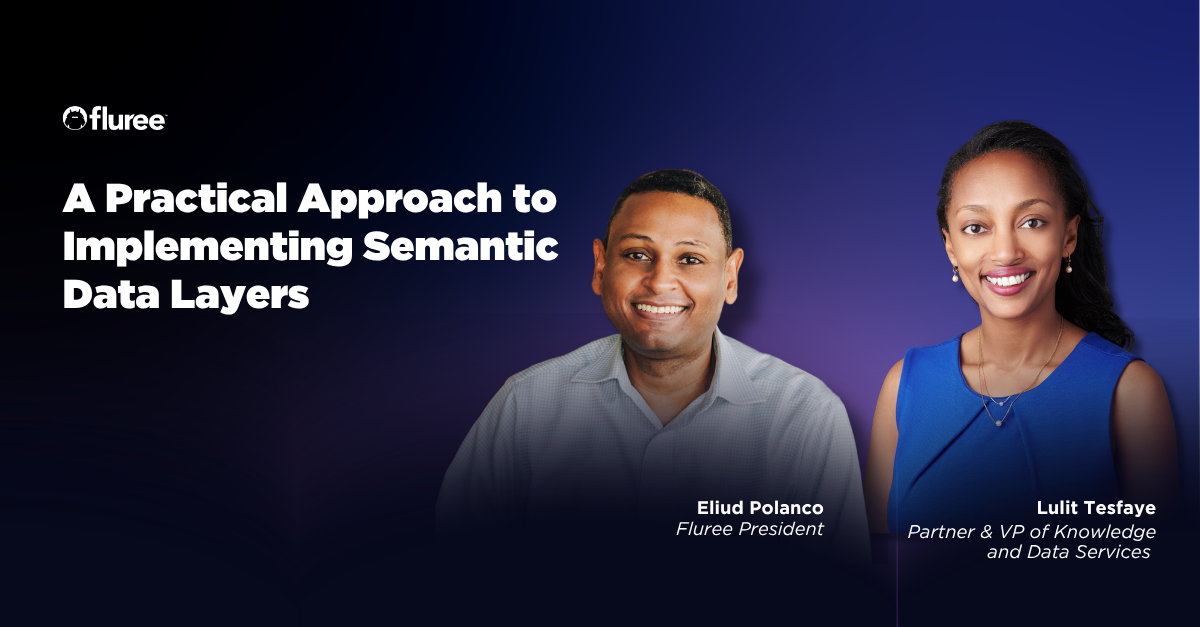
A Practical Approach to Implementing Semantic Data Layers
Strategy, governance, and rollout patterns — with Eliud Polanco (Fluree) and Lulit Tesfaye (Enterprise Knowledge).
Watch replay
How to Build a Semantic Layer for Enterprise AI
A practical walkthrough for moving from fragmented schemas to governed semantic intelligence.
Read the articleThe complete guide to retrieval, knowledge graphs & LLMs.
Download whitepaper
Controlling LLMs with Enterprise Taxonomies
Why controlled vocabularies improve retrieval quality, governance, and explainability.
Read the articleRecognized by Gartner

Your AI is only as smart as your semantic layer.
The knowledge graph is the engine. The semantic layer is the map. Without it, every AI answer is a guess. With Fluree’s AI-ready data platform, every answer is grounded in governed, verifiable meaning.