Neo4j vs GraphDB vs Stardog vs Neptune vs Fluree (2026)

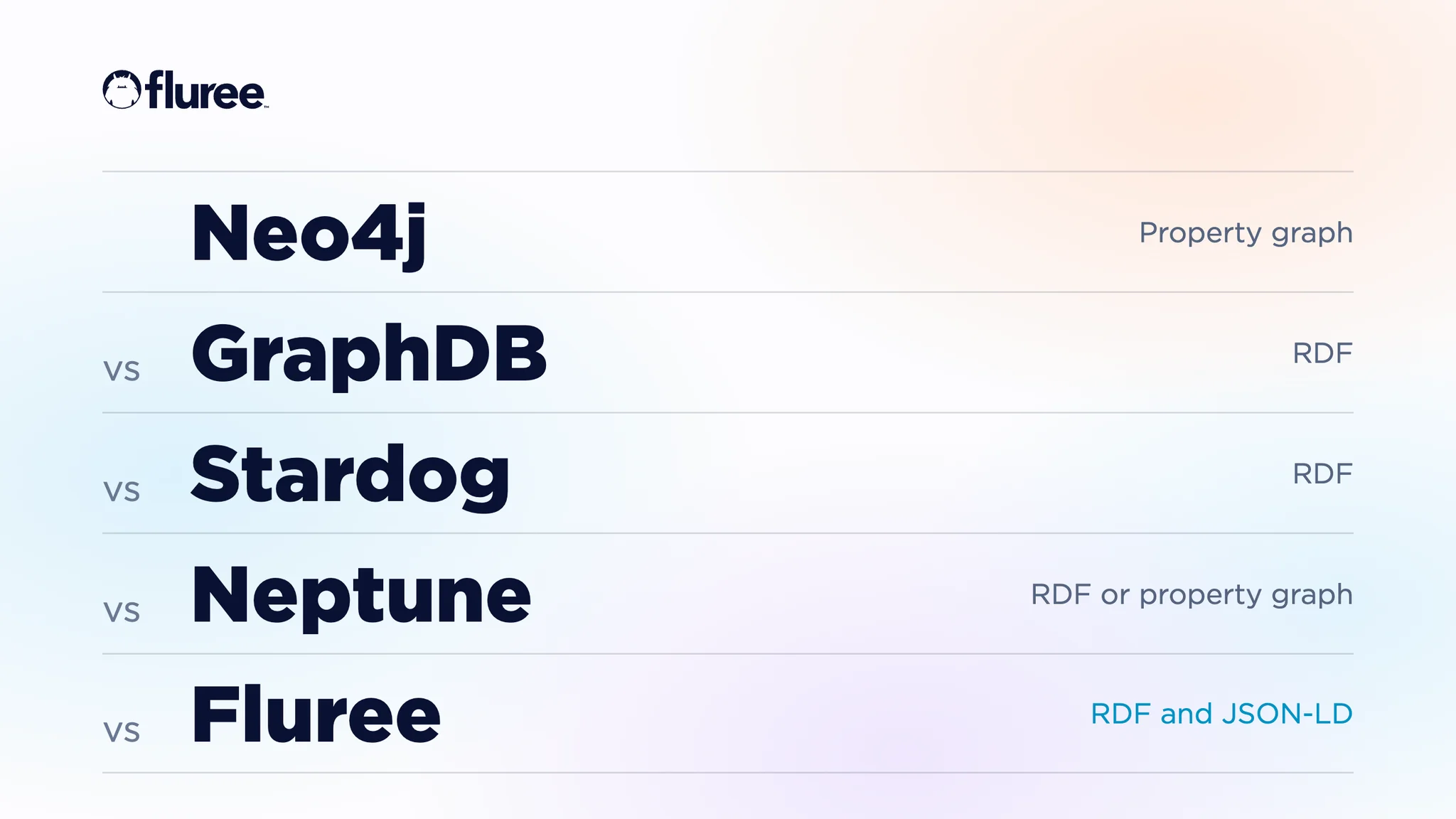
The short answer: pick Neo4j for developer-facing graph applications, GraphDB for standards-first RDF with reasoning, Stardog for live virtual graphs over many sources, and Amazon Neptune if you want a fully managed graph service on AWS. Pick Fluree if you need per-fact policy and the ability to query past states. Fluree is our product, and it isn’t the right default for most application graphs.
Every competitor fact below links to the vendor’s own pages and was checked on October 30, 2026.
The five at a glance
“None documented” means we didn’t find it in the vendor’s current docs, not that the vendor has ruled it out.
First decide: property graph or RDF?
This decision narrows the list more than any feature does. Our RDF vs LPG guide covers it in depth.
- Choose a property graph when one team owns one application graph, traversal speed matters most, and your developers already know Cypher.
- Choose RDF when data has to keep its meaning across systems, you need formal ontologies and reasoning, or you want identifiers and queries based on W3C standards.
- Neptune can hold both, but they stay apart. AWS’s FAQ says you can’t run a property graph query over RDF data, or the reverse. Choose one model per dataset.
- Fluree stores RDF but also accepts Cypher. That gets a Cypher team started, but it isn’t a drop-in Neo4j replacement.
Neo4j
Neo4j is the default for property graphs, with the largest ecosystem of the five.
- Query: Cypher. Cypher 25 arrived in 2025.06, and Neo4j publishes its GQL conformance status, including mandatory GQL features it doesn’t yet support.
- Access control: label, relationship type, property, and pattern privileges, on paid tiers only.
- AI: official MCP docs and a server that reached v2.0.0 on October 28, which requires APOC.
- Scale: Infinigraph is pitched at 100TB and up, with no named benchmark or tester in the announcement. It’s a separately licensed option.
- Where it falls short: it has no native RDF or SPARQL, and no native way to query past states.
Pricing: AuraDB Professional starts at $0.09/GB/hour with a 1GB minimum, and Business Critical at $0.20/GB/hour with a 2GB minimum. That’s about $66 and $146 per GB per month if left running. Community Edition is free under GPLv3, without high availability. Enterprise is by contact. For a closer look, read Neo4j’s limitations and our Neo4j alternatives guide.
GraphDB (Graphwise)
GraphDB is a long-standing RDF store with reasoning built in. Graphwise, formed when Ontotext and Semantic Web Company merged, took a majority investment from Oakley Capital in August 2026.
- Query: SPARQL 1.1, with RDF-star and SPARQL-star. GraphQL is a separate paid add-on.
- Reasoning: forward chaining in every edition.
- Access control: quad-level fine-grained access control, Enterprise only. It allows by default, and admins bypass it.
- AI: vector search through Elasticsearch or OpenSearch connectors, an MCP server added in 11.4, and a separate GraphRAG product.
- Where it falls short: each licensed core supports one concurrent query, so concurrency is tied directly to license cost. Vector search also needs a separate search engine.
Pricing: no public price; quotes depend on cores and deployment. GraphDB Free allows two concurrent queries and needs a requested license. The current licensing page calls it a “non-commercial option,” so check the terms before production use.
Stardog
Stardog is built around querying data where it lives. It’s the strongest of the five at live virtualization. See our Fluree vs Stardog comparison for detail.
- Query: SPARQL and GraphQL, plus a BI server for SQL clients.
- Reasoning: RDFS, OWL 2 QL, RL, and EL, plus user-defined rules, the broadest profile coverage in this comparison.
- Virtual graphs: live queries over external sources. Release 12.2 added SingleStore sources and Purview v2.
- Access control: named graph security, disabled by default, plus sensitive-property protection.
- AI: Voicebox for natural-language questions, and an MCP server for the Voicebox APIs whose remote setup is in Beta.
- Where it falls short: encryption at rest support was removed in 11.0.0, and its edge properties are based on early proposals that its own docs don’t recommend for new projects.
Pricing: Enterprise is by contact. The pricing page says Stardog Free has no commercial limitations, while the license agreement limits it to evaluation. Ask which applies.
Amazon Neptune
Neptune is the option for teams that want AWS to run the database.
- Query: Gremlin, openCypher, and SPARQL 1.1, with the property graph and RDF models kept separate.
- Reasoning: no built-in OWL reasoner, according to AWS’s own guidance. You materialize inferences or use an external reasoner.
- Access control: IAM read, write, and delete actions. We found no per-node or per-property control on that page.
- Scale: up to 128 TiB and 15 read replicas.
- AI: vector search is in the separate Neptune Analytics service, through openCypher only. An AWS Labs MCP server exists; it can run any query, including mutations, so scope its access carefully.
- Where it falls short: it runs only on AWS. You also get separate meters for instances, storage, and I/O, and engine 1.5.0.0 moves to TinkerPop 3.8, with semantic changes to check before upgrading.
Pricing: db.r5.large is $0.348/hour, storage is $0.10/GB-month, and I/O is $0.20 per million requests in US East. The I/O-Optimized option is $0.4698/hour with $0.225/GB-month storage.
Fluree
Fluree is an RDF knowledge graph on an append-only ledger. It’s our product, so weigh this section accordingly.
- Query: SPARQL, openCypher, GraphQL, and JSON-LD over one store.
- History: every commit is immutable, and a query can name any past transaction or time. You can also branch and merge.
- Access control: policy is stored as data and evaluated per fact inside the query engine.
- Reasoning: RDFS, OWL 2 QL and RL, and Datalog. There’s no OWL 2 EL.
- Data where it lives: Iceberg and Delta tables, plus SQL sources through Trino, Presto, or a small bridge.
- Benchmarks: self-run and reproducible, and not independent. The September 2026 DBLP run measured a 17.5 ms geometric mean, 11.5× QLever. A separate run loaded Wikidata at 21.1 billion distinct triples. Neither includes GraphDB or Stardog.
- Where it falls short:
- It has the smallest ecosystem here, and v4 only reached general availability in 2026.
- There’s no procedure library like APOC or GDS, and no visual ontology editor in FlureeDB.
- Its MCP endpoint is open by default until you turn on tokens, and it has two read-only tools.
- W3C SPARQL suites run in CI, with known gaps in a public skip register, including 11 tests in the core SPARQL 1.1 query categories. RDF 1.2 support is partial.
Pricing: FlureeDB is source-available under BUSL 1.1 and free to run in production. It isn’t open source: offering it as a hosted database service needs a commercial license, and each release converts to Apache 2.0 after four years. The hosted platform is free to start, with usage pricing on request.
Which should you pick?
No public benchmark covers all five, so run your own queries on your own data before you commit.
Frequently Asked Questions
Stay in the loop
Weekly insights on enterprise AI, knowledge graphs, and data intelligence.