Vector Database vs. Graph Database: Differences, Trade-offs, and When to Use Both

A vector database finds items that are similar in meaning: it stores embeddings, numerical representations of text, images, or audio, and returns the nearest ones to a query. A graph database stores explicit relationships between entities and answers exact questions that follow those relationships across several steps. Most AI systems that work on enterprise data need both kinds of retrieval. The real decision is whether they live in two systems you stitch together, or in one engine. FlureeDB, the engine under Fluree AI, is built for the second option: a graph database with vector and keyword search inside its queries, and access policy enforced on every fact it returns.
For the retrieval patterns themselves, and seven cases where graph retrieval beats similarity search, see GraphRAG vs. vector RAG. This guide compares the databases.
What is a vector database?
A vector database stores vector embeddings and finds the ones nearest to a query, with ordinary database features such as metadata filtering around that search (Pinecone). It is the storage layer behind most retrieval-augmented generation (RAG) systems.
Embeddings
An embedding model turns a piece of content into a list of numbers, often hundreds or thousands of them, so that content with similar meaning ends up close together (IBM). “Invoice overdue” and “payment past due” land near each other even though they share no words. A query is embedded the same way, and the database returns the stored vectors closest to it.
How similarity search works
Comparing a query with every stored vector is exact but slow at scale. Vector databases build indexes that find approximate nearest neighbors much faster, trading a little recall for speed (pgvector):
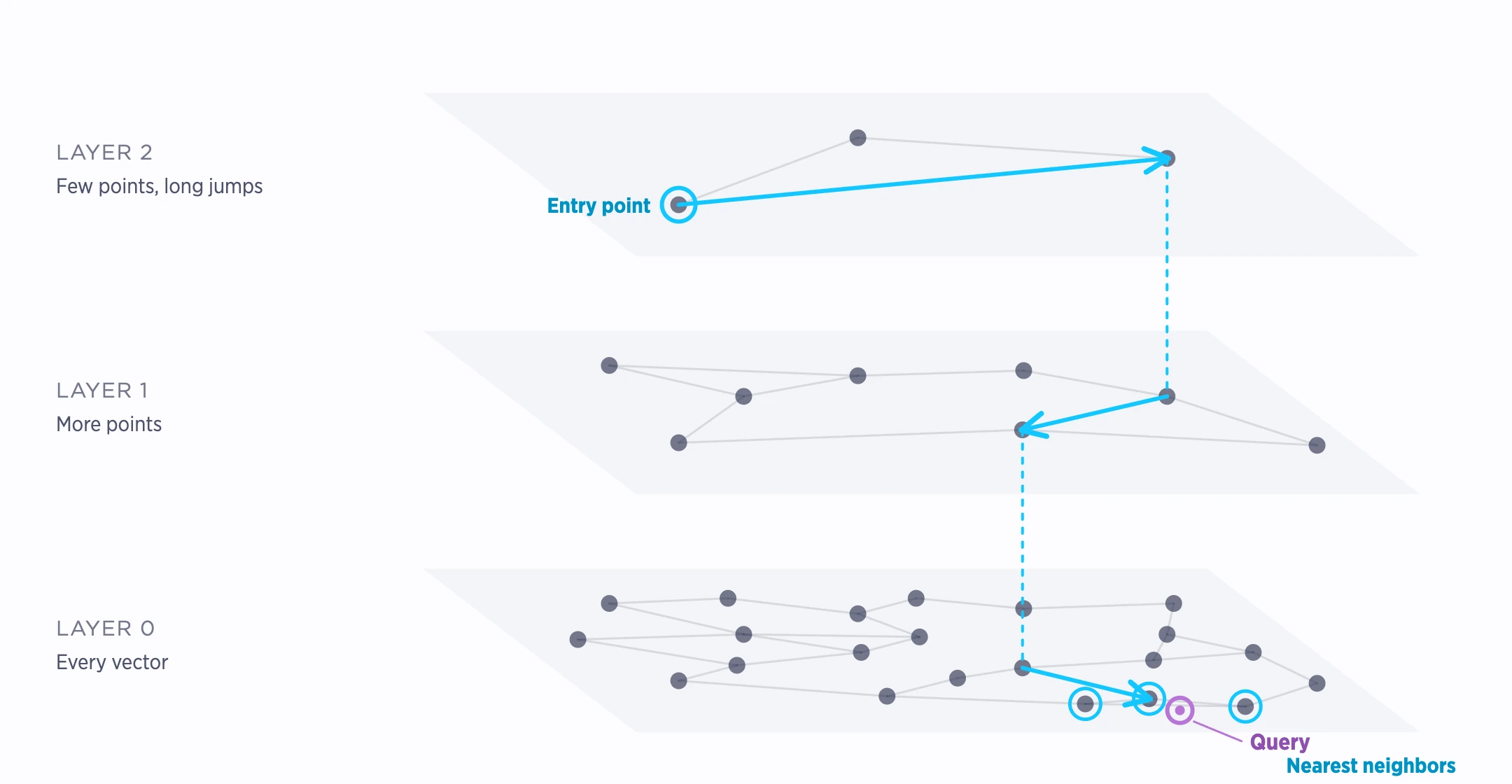
How an HNSW index searches: start on a sparse layer, move toward the query, drop down a layer, repeat. The result is approximate, which is why it is fast.
Distance metrics
Similarity is measured with a distance function. The common ones are cosine similarity (the angle between vectors, the usual default for text), dot product (fast, and equal to cosine when vectors are normalized to length one), and Euclidean distance (straight-line distance). Use whatever metric your embedding model was trained with.
Filtering and hybrid search
Real queries add conditions: only documents from this region, only this year. How a database combines filters with approximate search matters. pgvector, for example, applies filters after the index scan, so a filtered query can return fewer results than you asked for. Most vector databases now also offer hybrid search, which combines keyword ranking (BM25) with vector similarity so exact terms such as product codes still match (Weaviate).
Examples
- Dedicated vector databases: Pinecone, Weaviate, Milvus (Zilliz Cloud), Qdrant, Chroma. See our comparison of Weaviate alternatives.
- Extensions and search engines: pgvector for PostgreSQL, Elasticsearch, and OpenSearch.
- General-purpose databases with vector types: MongoDB Atlas, Oracle AI Database 26ai, Snowflake, and others.
- Graph databases with built-in vector search: FlureeDB, Neo4j, Amazon Neptune Analytics, and Memgraph. See the convergence below.
What is a graph database?
A graph database stores data as nodes (entities, such as a customer or a product) and edges (relationships, such as purchased or supplied by), with properties on both (Elastic). Queries describe a pattern of nodes and edges, and the database returns every exact match.
Property graphs and RDF
There are two main families:
- Property graphs put properties directly on nodes and edges and are queried with Cypher, openCypher, or GQL, which became an international standard, ISO/IEC 39075, in April 2024.
- RDF graphs store facts as subject–predicate–object triples with globally unique identifiers and are queried with SPARQL, a W3C standard since 2013. RDF connects naturally to ontologies, which define what each kind of thing means.
Our comparison of Neo4j, GraphDB, Stardog, Neptune, and Fluree covers the trade-offs between the two families.
Traversal and multi-hop queries
A graph query can follow relationships several steps deep: from a product to the suppliers of its parts, to the countries they operate in, to the sanctions that apply there. Some graph databases store direct pointers between connected records to make each step cheap; others use indexes over triples. Either way, the result is exact: these paths exist, and these are the entities on them.
Examples
- Property graph: Neo4j, Amazon Neptune, TigerGraph, Memgraph, FalkorDB.
- RDF and semantic graph: FlureeDB, Stardog, Ontotext GraphDB. (Neptune supports both, and FlureeDB also answers openCypher and GraphQL.)
For a broader view, see what a knowledge graph is: a knowledge graph is the model of entities and meaning; a graph database is one place to store it.
Vector database vs. graph database: key differences
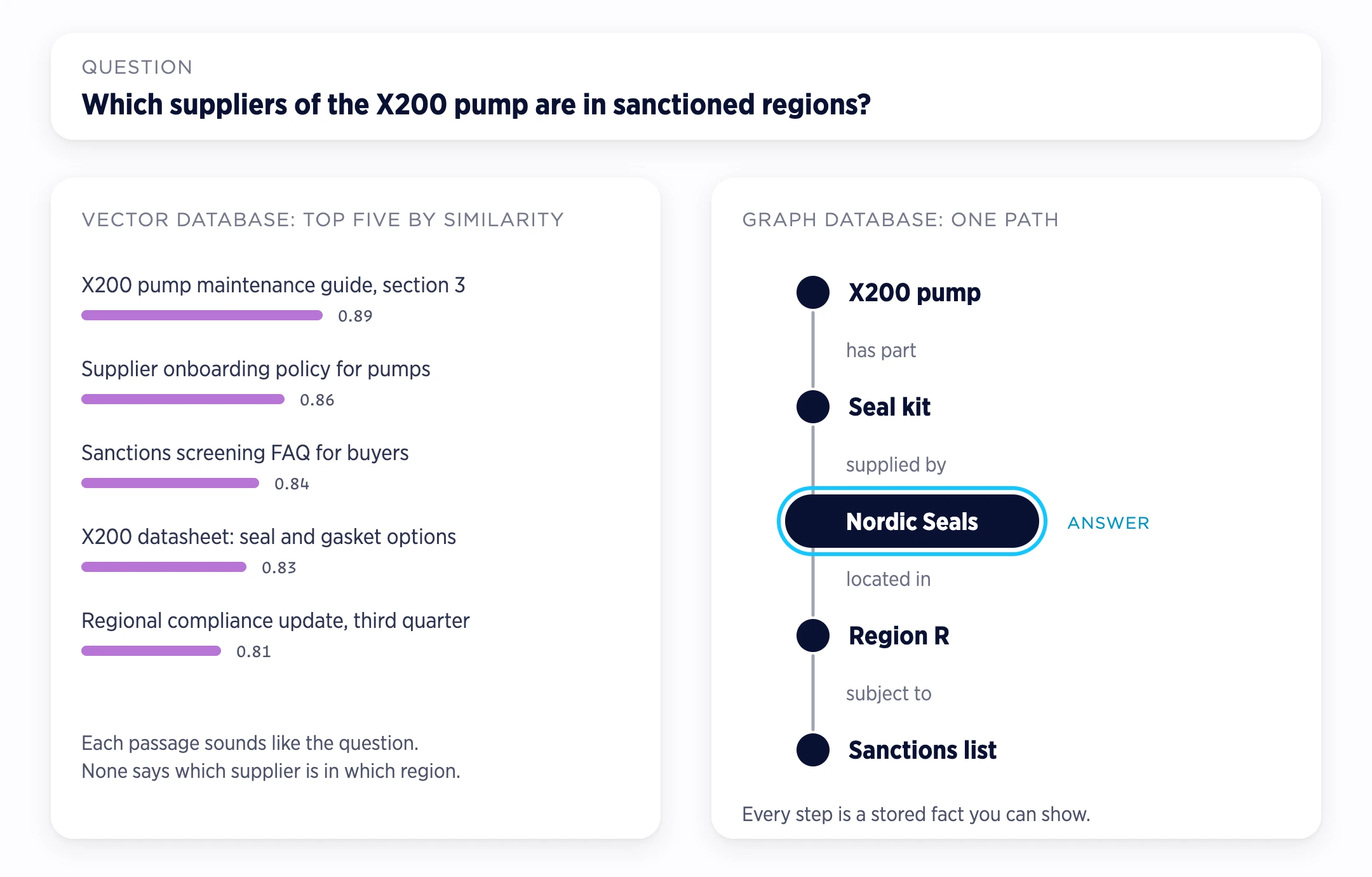
The same question, two retrievals (an illustrative example). Similarity finds passages that sound like the question; traversal finds the facts that answer it.
Where vector databases fall short
- No explicit relationships. Similar is not the same as related. A supplier contract and a sanctions notice may never sit near each other in embedding space, even though one determines the other. Even when a vector database supports links between objects, the links do not take part in the similarity search; Weaviate’s documentation notes that a vector search cannot filter on properties of a linked object.
- Approximate, not exact. Approximate indexes can miss a relevant item, and filtered searches can return fewer results than requested.
- Weak at counts and whole-collection questions. “How many open orders does Acme have?” needs exact records, not similar passages. Microsoft’s GraphRAG paper found that standard retrieval does poorly on questions about a whole corpus.
- Hard to explain. A similarity score says how close two vectors are, not why an item is the answer.
- Memory and migrations. HNSW indexes are held in memory; Weaviate’s planning guide estimates about twice the raw vector size. One million 1,536-dimension vectors at four bytes per number is about 6 GB raw, or about 12 GB by that rule. And vectors from different embedding models cannot be compared, so changing models means re-embedding everything (Qdrant).
Where graph databases fall short
- Modeling comes first. A graph needs a model of your entities and relationships, which is more up-front work than loading vectors.
- Text has to be extracted. Documents become graph data only after entities and relationships are pulled out of them, usually by a model. Microsoft’s GraphRAG indexing of a corpus of about one million tokens took 281 minutes in the paper’s setup.
- Fuzzy matching needs help. A graph query matches exact patterns. Finding “things like this” needs full-text or vector search alongside it.
- Not every engine handles vectors well. In Amazon Neptune Analytics, for example, a graph has one vector index, fixed when the graph is created, and vector updates are not atomic.
The convergence: vector search inside graph databases
Since 2023 the categories have blurred:
Sources: Neo4j, AWS, MongoDB, Snowflake, Oracle, Fluree (our product).
The convergence is uneven. A graph database with a vector index can combine the two in one query, but the details matter: whether vector results can be joined with graph patterns, whether permissions apply to them, and whether updates are transactional. In Fluree DB, for example, a vector search is one more pattern in a SPARQL query, so its results join with graph facts and pass through the same access policy as everything else (how it works). A vector database with links can store relationships, but it does not traverse them.
What the research says
Three studies are often cited. Each needs its caveat.
- Knowledge graphs and enterprise questions. Sequeda, Allemang, and Jacob (data.world, 2023) found GPT-4 answered enterprise business questions correctly 16% of the time when querying SQL databases directly, and 54% when the same data was represented as a knowledge graph. Caveat: this compares SQL with a knowledge graph, not vector search with a graph. It shows that explicit meaning helps.
- Graph-based retrieval on whole collections. Microsoft’s GraphRAG paper (2024) found graph-based approaches beat standard vector retrieval on the comprehensiveness of answers 72–83% of the time on podcast transcripts and 72–80% on news. Caveats: a language model judged the answers, the questions were about whole collections, and the paper notes that vector retrieval gave the most direct answers.
- A production result. LinkedIn’s customer service team (2024) combined a knowledge graph with retrieval and reported a 77.6% improvement in retrieval quality (mean reciprocal rank) over a baseline, and a 28.6% drop in median time to resolve issues after about six months in use.
Together they point the same way: use vectors for “find me the passage about this,” and graphs for “connect, count, and explain.” Fluree’s own 2024 study reached a similar conclusion for knowledge graphs compared with relational retrieval.
Security, governance, and provenance
This is the difference most comparisons skip, and the one that matters most once agents act on the answers.
- Vector databases usually separate tenants with namespaces or collections and handle per-user access with metadata filters. Pinecone’s documentation, for example, calls filtering on large lists of user IDs an anti-pattern and recommends namespaces or filtering in the application instead (Pinecone). Either way, a permission is something the application has to remember to apply.
- Graph databases vary widely. Neo4j offers privileges by label, relationship type, and property in its Enterprise and higher cloud editions (Neo4j). FlureeDB enforces policy on every individual fact at query time, by attribute, role, or relationship, so every result, including a vector search result, is filtered before it reaches the caller. The application cannot forget to apply it.
- Provenance and history are rare in vector stores. In graph engines built on immutable history, such as FlureeDB, every change is a signed transaction, and you can ask what a fact was on a given date and who changed it. See context graphs versus knowledge graphs for why that matters to agents.
How to choose
A vector database alone fits when:
- Questions are mostly “find the passage about this” over documents
- You do not need relationships, counts, or exact values
- Access rules are simple enough for namespaces or collections
- You want the fastest path to a working prototype
A graph database fits when:
- Questions cross entities: suppliers, owners, accounts, parts, regulations
- Answers must be exact, explainable, and traceable to sources
- Access policy depends on who is asking and what the data is
- The same entities appear in many systems and need one identity
Both, in one engine, fit when:
- You have documents and records, and questions that need both: “what does the contract say, and which accounts does it cover?”
- Agents act on the answers, so every result has to respect who is asking
- You would rather run one system than keep a vector store, a graph, and a permission layer in sync
Two systems mean two copies of your entities, two permission models, and application code to join them. One engine that does both, such as FlureeDB, means vector results are joined, filtered, and governed like any other data. (If all you need is similarity search over billions of raw embeddings with no entity model, a dedicated vector database is the simpler tool.)
One engine for both: FlureeDB
FlureeDB is a graph database built on W3C standards (RDF, SPARQL, OWL, SHACL) that runs keyword and vector search inside the engine. It is the engine under Fluree AI, and you can also run it yourself.
- Vector and keyword search in the query. HNSW vector similarity and BM25 full-text ranking are patterns in a graph query, so a single query can find similar passages, follow their relationships, filter, and count.
- Access policy on every fact. Attribute, role, and relationship-based policies are enforced inside the engine on each fact it returns, vector matches included. An agent sees only what the person it acts for may see.
- Every answer traceable. Every transaction is signed, history is never overwritten, and you can query the graph as it stood at any point, to show what an agent knew when it answered.
- Meaning, not only similarity. OWL and RDFS reasoning and SHACL validation work on the same data, so the graph knows that a subsidiary is a company and a seal kit is a part.
- No new silo. FlureeDB queries Apache Iceberg, Parquet, and relational sources (through R2RML) as part of the same graph, without copying the data.
- Ready for agents. A built-in MCP server lets AI agents query the graph directly, under the same policies.
Compared with running a vector database beside a graph database, that removes a sync pipeline, a second permission model, and the application code that joins the two.
Frequently Asked Questions
Stay in the loop
Weekly insights on enterprise AI, knowledge graphs, and data intelligence.