One Intelligence Layer, From Supplier Contract to Shelf: Fluree for Consumer Packaged Goods


Consumer packaged goods might be the most decision-dense industry in the world. Every week, a large CPG manufacturer negotiates with retailers, allocates trade dollars, reprices against commodity swings, reroutes around supplier problems, tunes production lines, and decides where the next marketing dollar goes. Each of those decisions depends on context from somewhere else in the value chain — and in almost every CPG organization, that context is scattered across systems that were never designed to talk to each other.
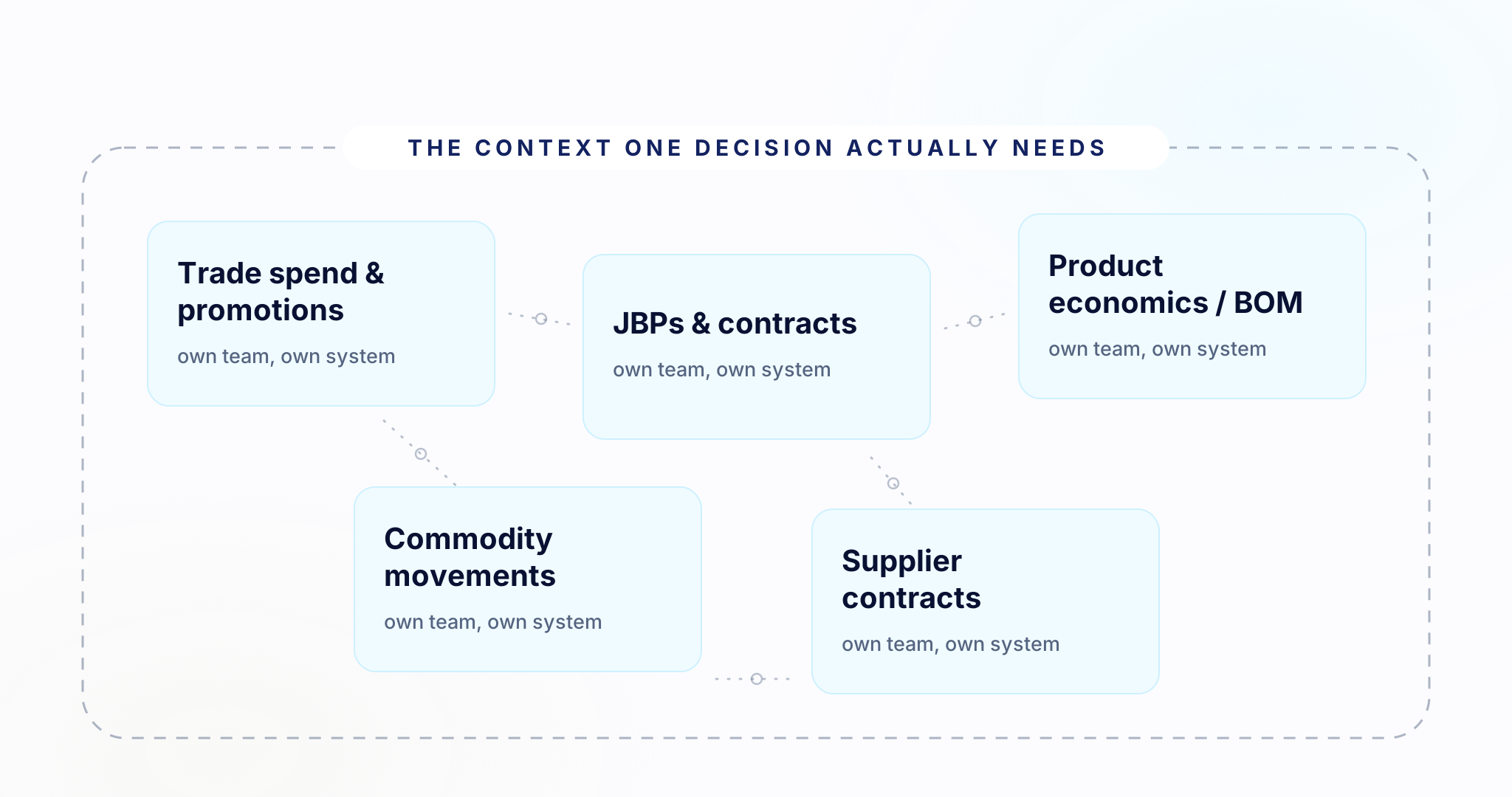
The scale of the fragmentation is easy to underestimate until you measure it. When Fluree was brought in by one of the world’s largest food and beverage companies — twenty-plus brands, each generating more than a billion dollars in revenue — to unify product data from five internal and external sources, we discovered that 48% of product records with unique IDs were duplicates. Nearly half. Every downstream decision — pricing, promotion, inventory, retail execution — had been quietly inheriting that distortion. And this is a company with world-class data teams. Industry research suggests most organizations put less than 10% of their total data potential to work.
For years, this was an efficiency problem. Companies absorbed it with reconciliation teams, spreadsheet heroics, and institutional memory. But agentic AI changes the stakes entirely. AI agents can now genuinely participate in commercial and operational workflows — monitoring, recommending, even negotiating. An agent, unlike an analyst, cannot walk down the hall to ask whether the number looks right. Whatever fragmentation exists in your data, agents will operate on it at machine speed.
Which means the question facing every CPG leader is no longer whether to deploy AI. It’s what the AI will be standing on.
The copilot trap
The instinctive answer is to buy AI where you already buy software: a copilot in the trade promotion tool, a chatbot in the supply chain suite, an assistant in the CRM. Each vendor is racing to add one.
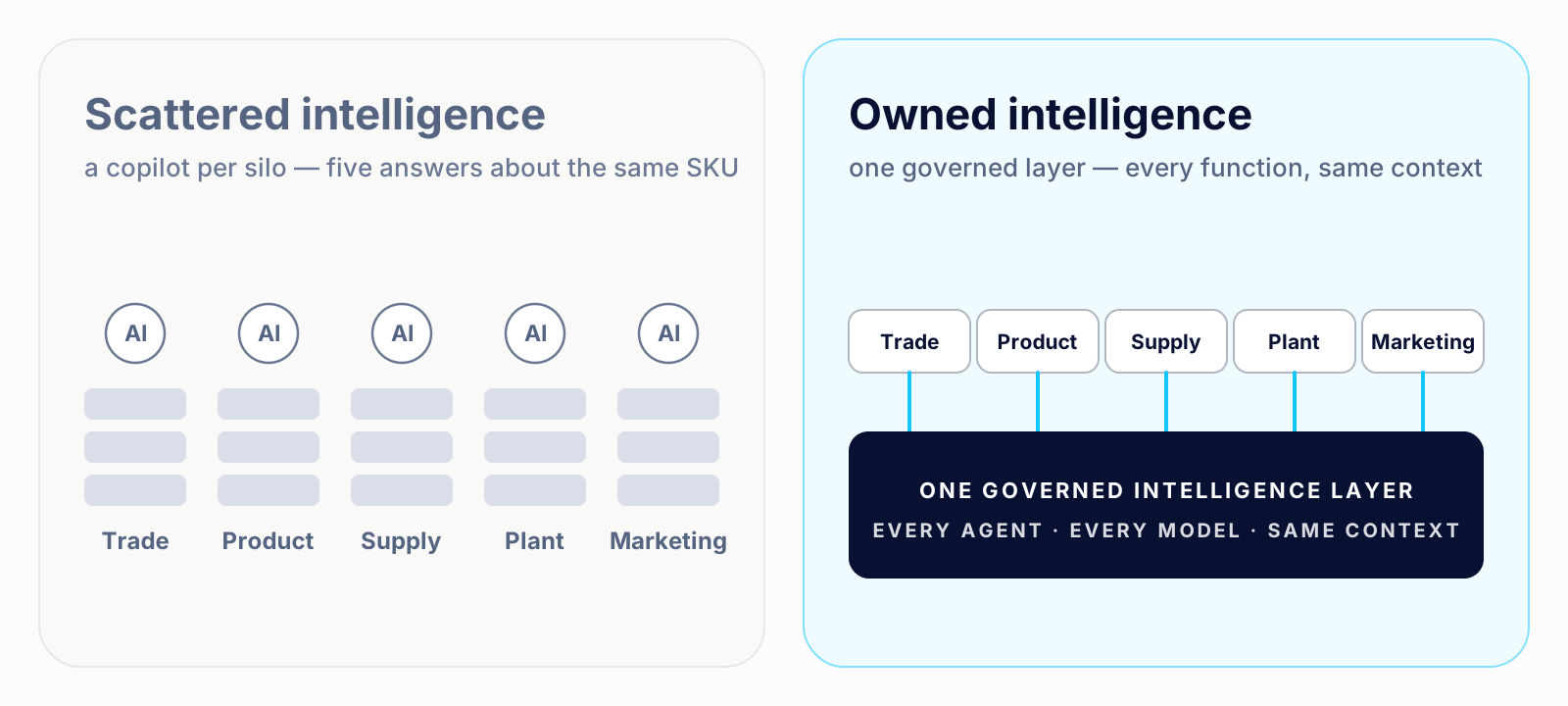
The problem is that this approach hardens the very silos that created the fragmentation. Five copilots reasoning over five fragments will give you five different answers about the same SKU — each confidently, none with visibility into the others’ context. Worse, the intelligence itself ends up scattered and rented: your promotion logic lives in one vendor’s model, your supply logic in another’s, and none of it compounds.
There’s a different architectural answer: put one governed intelligence layer underneath the functions, so that any agent, any AI model, and any interface reasons over the same connected, permissioned context. Your data stays where it lives. What gets unified is the meaning — the entities, relationships, and business vocabulary that turn scattered records into a picture of your actual business. That’s what a semantic knowledge graph does, and it’s what Fluree builds.
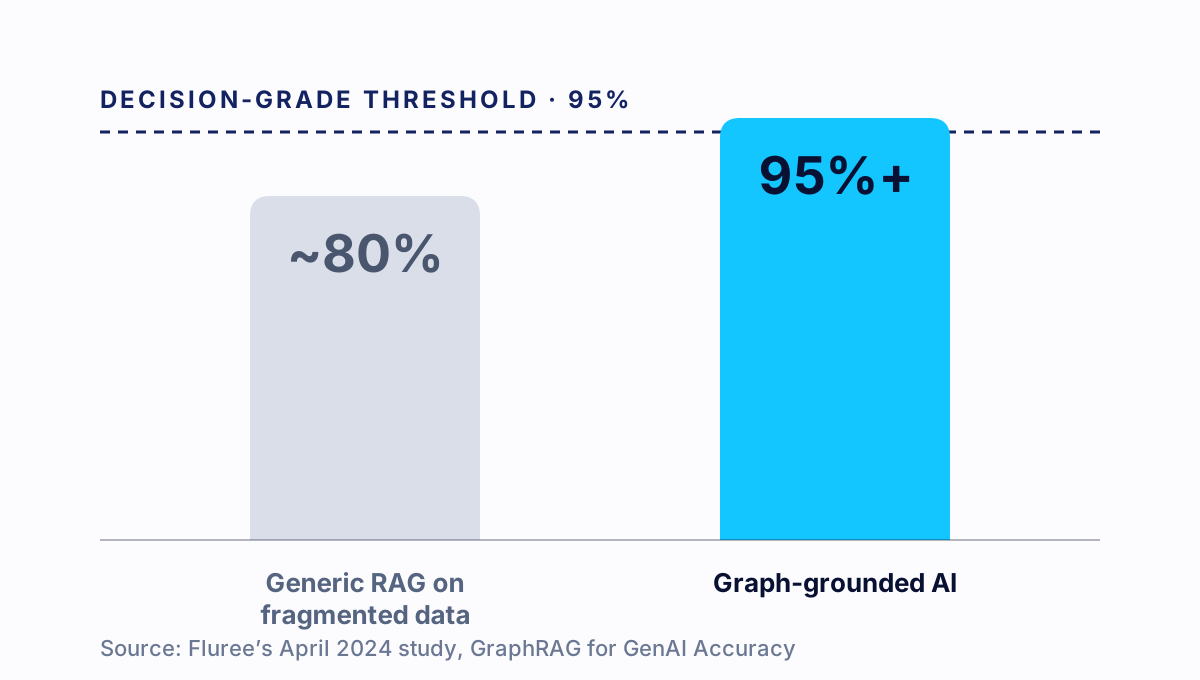
The distinction matters more than it sounds, because of a hard threshold in AI accuracy. Retrieval over fragmented, ungoverned data plateaus at roughly 80% accuracy — fine for drafting an email, disqualifying for decisions with money attached. Grounding AI in a governed knowledge graph — explicit relationships, definitions, and provenance — pushes accuracy to 95% or higher, with every answer carrying its citations. Fluree’s April 2024 study, GraphRAG for GenAI Accuracy, measured that spread directly across retrieval architectures. For decisions involving trade budgets, contract terms, or supplier commitments, that fifteen-point gap is the difference between a useful tool and a liability.
What the intelligence layer actually does
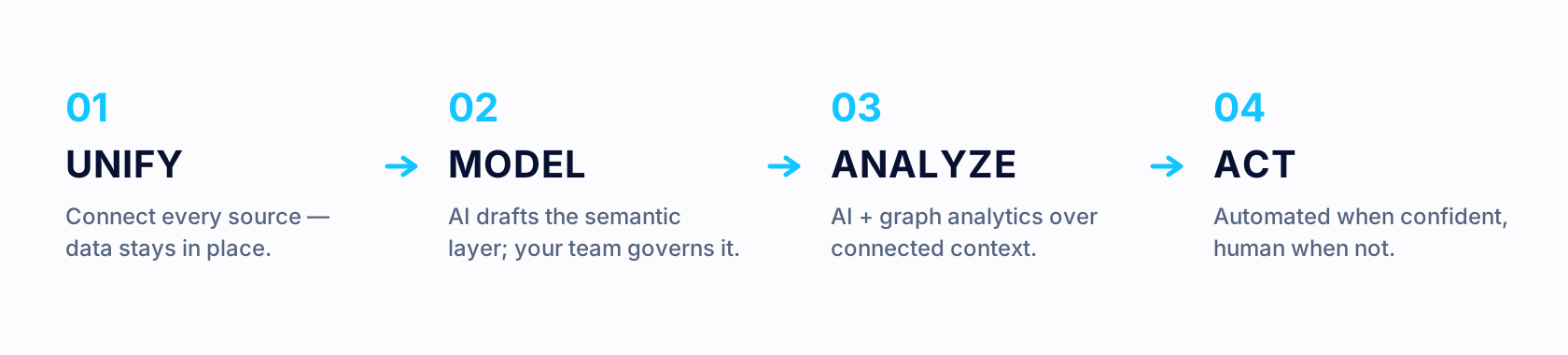
Fluree’s approach to decision intelligence runs in four stages on one governed graph.
Unify. Connect the sources — multiple ERP instances, PLM systems, plant-floor OT, retailer and third-party feeds, trade systems, contracts, CRM, documents — into one governed view. Data stays in place; context gets connected.
Model. AI drafts the semantic layer — the entities, relationships, and shared vocabulary of your business — and your team governs and publishes it. “Customer,” “SKU,” and “promotion” finally mean the same thing everywhere.
Analyze. Questions asked in plain English become verified queries against governed data. AI and graph analytics surface patterns siloed tools structurally cannot see — because the connections literally don’t exist in any one system.
Act. Decision flows execute: automated where confidence is high, escalated to humans where it isn’t, with every action logged, cited, and reversible.
And critically, trust is built into the data itself rather than bolted onto each application. Access policy is enforced at the data layer — per user, per agent, evaluated at query time. Every answer traces to the records and relationships behind it, backed by an immutable audit trail. That’s what makes it safe to let agents act: governance, semantics, and lineage travel with the data, so every new agent inherits trust automatically instead of re-implementing it. The result functions as an enterprise memory — persistent, governed, reusable business understanding that records not just what is true but what was known when, so decisions can be explained, audited, and improved after the fact.
Here’s what that foundation makes possible across the CPG value chain.
Trade promotion: where fragmented context costs the most
Start with the money. Trade spend — the discounts, allowances, and promotional funding CPG companies pay retailers — typically runs 15–25% of gross sales, making it the second-largest line on the P&L after cost of goods sold, and an estimated half a trillion dollars annually across the industry. Entire revenue growth management (RGM) organizations exist to optimize these levers. Yet industry research has long suggested that a large majority of promotional spend fails to generate profitable incremental growth. The second-biggest cost in the business is also its least understood.
The root cause isn’t a lack of TPM software. It’s that a trade decision needs context that lives outside the trade system: contract terms sit in legal repositories, product economics in ERP, commodity exposure in procurement, account profitability in finance. The negotiation is the point of action, but the economic decision spans the value chain — which is why every negotiation happens with a partial picture.
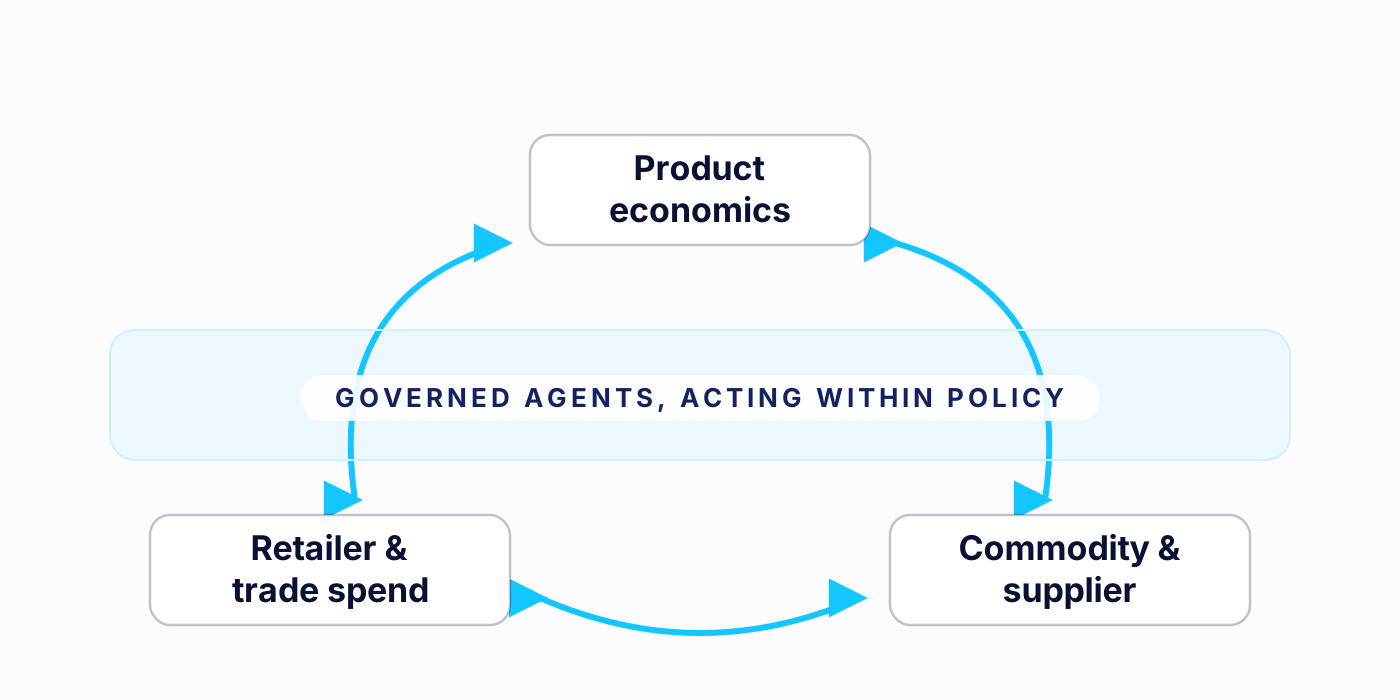
Connected on a governed knowledge graph, that changes — revenue growth management starts to become agentic. Five capabilities become practical:
- Profitable retailer negotiation. Promotion performance, trade spend, and account profitability enter the negotiation context together — so the question of whether prior promotions created profitable incremental growth or simply eroded margin gets asked before the next retailer conversation, not in a post-mortem two quarters later. Attribution will always be contested; what the graph changes is that the baselines, assumptions, and data behind any attribution claim are connected, visible, and auditable instead of buried in someone’s model.
- Governed agent-to-agent negotiation. As retailers deploy their own buying agents, CPG agents need to show up with more than offers — they need to honor the commitments already in force. On Fluree, agents carry the relevant JBP terms, contract dates, commodity baselines, and data-access constraints into every interaction — negotiation with commercial and contractual context, enforced by policy rather than by prompt.
- Margin and cost exposure behind the retailer ask. The SKUs and live promotions in a negotiation connect directly to commodity movements, bill-of-materials composition, and supplier contract pricing — so commercial teams see how upstream changes shape the margin actually available downstream.
- Supplier and sourcing exposure. The graph maps supplier concentration to the commodities, SKUs, and promotions exposed to it — revealing when the real constraint in a commercial conversation is upstream risk, not retailer pressure.
- Closed-loop margin optimization. Retailer performance and trade spend connect through product economics to commodity and supplier context — the whole margin equation, customer side and supplier side, optimized together instead of negotiated one fragment at a time.
No point solution can draw that loop, because no point solution holds both ends of it.
Product and catalog intelligence
Everything downstream of product data inherits its quality. Product information arrives from retailers, distributors, and data providers in inconsistent, duplicated, untrustworthy form — which is how a Global 500 CPG ends up with 48% duplicate records and no reliable answer to “how much of this size and flavor did we sell this quarter?”
In that engagement, Fluree built a unified product catalog from five disparate sources with 97.5% data accuracy — in a three-week end-to-end proof of concept. The system classified records against the client’s master catalog, inferred and filled missing critical attributes (including standards like GTIN-14), deduplicated across sources under a unifying master ID, and learned to distinguish the granular nuances that trip up generic tools: concentrates versus liquids, package sizes, flavors. Manual remediation that had taken months compressed into days. As the client’s VP of Data Engineering put it, three weeks with Fluree produced more insight into their product data ecosystem than they had ever been able to generate before without enormous manual effort.
Supply chain, sourcing, and the BOM problem
When a supply disruption hits, the substitute component usually exists — described differently, in a system the sourcing team can’t search. Every ERP and PLM instance carries its own conventions for materials, components, and work orders; suppliers layer their own SKUs and spec formats on top. The result: slow disruption response, redundant components, and safety stock as a coping mechanism.
Fluree standardizes component and material descriptions across departments and supplier catalogs, connecting engineering designs to procurement and production in one semantic model. Equivalent parts become findable in minutes. Supplier concentration risk becomes visible before it becomes a crisis — and, connected to the commercial graph above, sourcing exposure becomes part of trade and pricing decisions rather than a separate conversation.
There’s a timing dimension here that structured data alone misses. In the commercial graphs we build, roughly half the facts a decision needs come from systems of record. The other half — the ones that arrive early and say whether an action is even permitted — come from documents: supplier allocation and force majeure notices, supply agreements with their price-adjustment caps and notice periods, JBP amendments that lock a promotion window months before the trade system reflects it. Because Fluree extracts document-derived facts into the same governed graph, with provenance, that lead time becomes usable signal instead of hindsight.
Manufacturing: closing the IT/OT gap
Smart Factory programs generate enormous operational data — and most of it never meets the business systems that could give it meaning. Sensor telemetry, line controls, and quality measurements stay disconnected from ERP, logistics, and finance, so plants can’t correlate equipment performance with product margin, and maintenance stays reactive in an industry where unplanned downtime is estimated to cost tens of thousands of dollars per minute.
Linking real-time OT data with business context on one graph lets plant leaders see how equipment behavior drives margin, quality, and delivery commitments — and lets maintenance be prioritized by business impact instead of arbitrary schedules. It’s the same architectural move as trade promotion, applied to the plant floor: decisions improve when the context finally connects.
Customer and channel intelligence
The same entity-resolution engine that unifies products unifies customers. Account data fragments across marketing, sales, service, and finance — often across multiple instances of the same CRM — while traditional MDM programs take six months or more to deliver a customer 360 that still mismatches. Fluree’s AI-driven approach has delivered governed customer views in roughly eight weeks versus the thirty-plus typical of conventional programs, at a fraction of the staffing — giving commercial teams relationship history, cross-sell visibility, and account-level profitability they can actually trust.
Marketing intelligence: the AI Agent Factory
For a picture of where all this leads, look at one of Europe’s leading beauty and cosmetics companies. Rather than commissioning one-off AI pilots, it is implementing an AI Agent Factory with Fluree: a repeatable operating model — defined roles, five core processes, and a governed knowledge layer — for creating, deploying, and running AI Knowledge Agents at enterprise scale.
The first agents make marketing-mix models conversational: a marketing leader can ask how much to spend on Instagram and YouTube to grow a product line 20% in the DACH region next quarter, and get a grounded, explainable recommendation drawing on spend history, attribution data, and external factors. The same semantic foundation powers product intelligence for external AI and search platforms, and an internal product-knowledge agent for social media response teams. Every agent is governed by four KPIs: time to market, provable cited accuracy, timeliness, and role-based data privacy.
The transferable lesson for CPG isn’t the marketing use case — it’s the factory. Because the semantic foundation is reusable, the company’s second agent cost a fraction of its first, and its tenth will follow a paved path. The same pattern applies to trade agents, sourcing agents, and plant agents.
The modernization on-ramp
For many CPG organizations, the practical entry point isn’t a moonshot — it’s a migration that’s already on the roadmap. SAP’s 2027 end of mainstream maintenance for legacy ERP has put data migration in the critical path at thousands of manufacturers, and surveys consistently rank data cleansing and harmonization as the hardest part. Fluree’s data-first approach automates discovery, cleansing, mapping, transformation, and transfer — cutting migration cost and timeline dramatically while producing something traditional migrations never leave behind: a clean, semantically modeled data foundation that outlives the project. One large North American pharmaceutical manufacturer used this approach to consolidate more than ten data warehouses onto a single environment, eliminate $3M in manual data operations, and compress new analytics use cases from nine months to three weeks.
That’s the quiet strategic point: the migration you have to do anyway can fund the intelligence layer you need next.
Start with one decision
None of this requires a platform migration or a multi-year program. The pattern that works: pick one high-value decision domain — one category’s trade promotions, one region’s product catalog, one plant’s maintenance triage. Connect its sources, let AI-assisted modeling draft the semantic layer, and put governed decisioning in front of the team that owns the decision. Most teams ship a working, governed foundation in four to eight weeks. From there, expansion is incremental — new sources join without reintegration, approved decisions and their outcomes enrich the context for the ones that follow, and automation grows exactly as fast as trust does.
The CPG companies that win the next decade won’t be the ones with the most copilots. They’ll be the ones whose value chain can finally see itself — and whose agents act on that picture with context, citations, and control.
See it on your own data: talk to us about a four-to-eight-week starting domain, explore Fluree for Consumer Packaged Goods, or reach us directly at info@flur.ee. And if you would rather test the argument than read it, the CPG demo kit is a loadable knowledge graph with twenty-six packaged competency questions. It runs on a free Fluree workspace in about two minutes.
Stay in the loop
Weekly insights on enterprise AI, knowledge graphs, and data intelligence.