Fluree Blog Blog Post Kevin Doubleday03.17.26

How to Build a Semantic Layer for Enterprise AI

The enterprises that succeed with AI in the next decade will not be those deploying the most models. They will be the ones whose models operate from a common, governed, semantic foundation.

Here’s an uncomfortable statistic: according to a March 2026 report from Cloudera and Harvard Business Review Analytic Services, only 7% of enterprises say their data is completely ready for AI. Not 70%. Seven.

Meanwhile, organizations are pouring billions into AI initiatives. Global enterprise AI investment surpassed $684 billion in 2025, yet more than 80% of that spending failed to deliver intended business value, according to research compiled by Pertama Partners. MIT’s Project NANDA found that roughly 95% of generative AI pilots show no measurable P&L impact. Gartner forecasts that more than 40% of agentic AI projects will be abandoned by 2027.

The pattern is unmistakable: the AI technology works. The data foundation doesn’t.

The missing piece is a semantic layer — a structured, governed abstraction that translates raw enterprise data into business meaning that both humans and AI systems can trust. In 2026, the semantic layer has moved from a nice-to-have analytics optimization to the essential infrastructure for any enterprise AI initiative that expects to reach production.

This guide walks through what a semantic layer is, why it matters for enterprise AI, how to build one, and how knowledge graph technology transforms it from a static metadata catalog into a living intelligence fabric that can push AI accuracy from the ~80% ceiling most organizations hit today to 95% and beyond.

What Is a Semantic Layer for Enterprise AI?

A semantic layer is an abstraction that sits between your raw data sources and the applications — dashboards, AI agents, LLMs — that consume that data. It defines what business terms mean, how metrics are calculated, how entities relate to one another, and who is authorized to see what. Think of it as the shared business vocabulary your entire technology stack agrees on.

In a traditional BI context, semantic layers ensured that Marketing and Finance both used the same definition of “active customer.” That was useful. In an AI context, the stakes are exponentially higher. When an LLM agent interprets “gross margin by region” differently than your CFO does — because it’s reading raw schema names like cst_gds_sld and guessing — you don’t get a dashboard discrepancy. You get a confidently wrong decision, delivered at machine speed, with no one in the loop to catch it.

The Five Components of an Enterprise Semantic Layer

A robust semantic layer isn’t a single technology — it’s an architecture built from multiple interlocking components, each adding a layer of meaning and governance to raw data:

The five components of an enterprise semantic layer

Each layer adds meaning and governance to raw data — most BI tools cover only the first three.

WHAT ENTERPRISE AI REQUIRES
5
Knowledge graph
Operationalizes the ontology by linking real-world entities and relationships across datasets, powering contextual insights and unified data access through graph-based connections. This is the component that transforms a semantic layer from a metadata catalog into a reasoning-capable intelligence fabric.
4
Ontology
Formally models entities, attributes, and relationships — capturing domain semantics and enabling structured, relationship-aware views of data that go far beyond simple hierarchies or tabular formats. Ontologies are typically expressed using W3C standards like RDF and SKOS.
WHERE MOST BI SEMANTIC LAYERS STOP ↑
3
Business glossary
Defines key terms across teams, aligning business and technical language so that AI systems inherit the same shared understanding human analysts rely on.
2
Taxonomy and information architecture
Structures business terms into hierarchies that support cross-functional alignment. When your sales team’s “prospect” is your support team’s “client” and your finance team’s “counterparty,” a taxonomy maps these variations to a consistent entity definition. Learn more about controlling LLMs with enterprise taxonomies →
1
Metadata
Enriches datasets with context like source, lineage, quality, and security classifications. This is the connective tissue that makes data discoverable and interpretable across the organization.

Most BI-oriented semantic layers (dbt MetricFlow, AtScale, Cube) focus primarily on the first three components — metadata, taxonomy, and business glossary — to ensure consistent metric definitions across dashboards and reports. These are valuable tools, but they primarily solve a query translation problem: converting business questions into optimized SQL against a well-modeled warehouse. For enterprise AI, you need the full stack — particularly ontologies and knowledge graphs — to solve the harder upstream problem of unifying and connecting data across heterogeneous sources before any query is written.

Industry analyst coverage in early 2026 has converged on this point. Gartner elevated the semantic layer to essential infrastructure in the 2025 Hype Cycle for BI & Analytics. BigDATAwire reported that roughly 40% of enterprise leaders now see the absence of semantic context as a major blocker for operational AI. The message is consistent: AI without governed semantics cannot scale in enterprise environments.

The 80% Accuracy Ceiling: Why Traditional RAG Isn’t Enough

Most organizations building enterprise AI today are using some form of Retrieval Augmented Generation (RAG) — teaching LLMs to pull information from external data sources rather than relying solely on their training data. This is a necessary step, but the implementation details determine whether you get reliable intelligence or expensive hallucinations.

The most common RAG approach connects LLMs to vector databases, which store unstructured data as mathematical embeddings. When a user asks a question, the system retrieves chunks of text that are semantically similar to the query and feeds them to the LLM for response generation. This works reasonably well for straightforward document retrieval — finding the right paragraph from a policy manual, for instance.

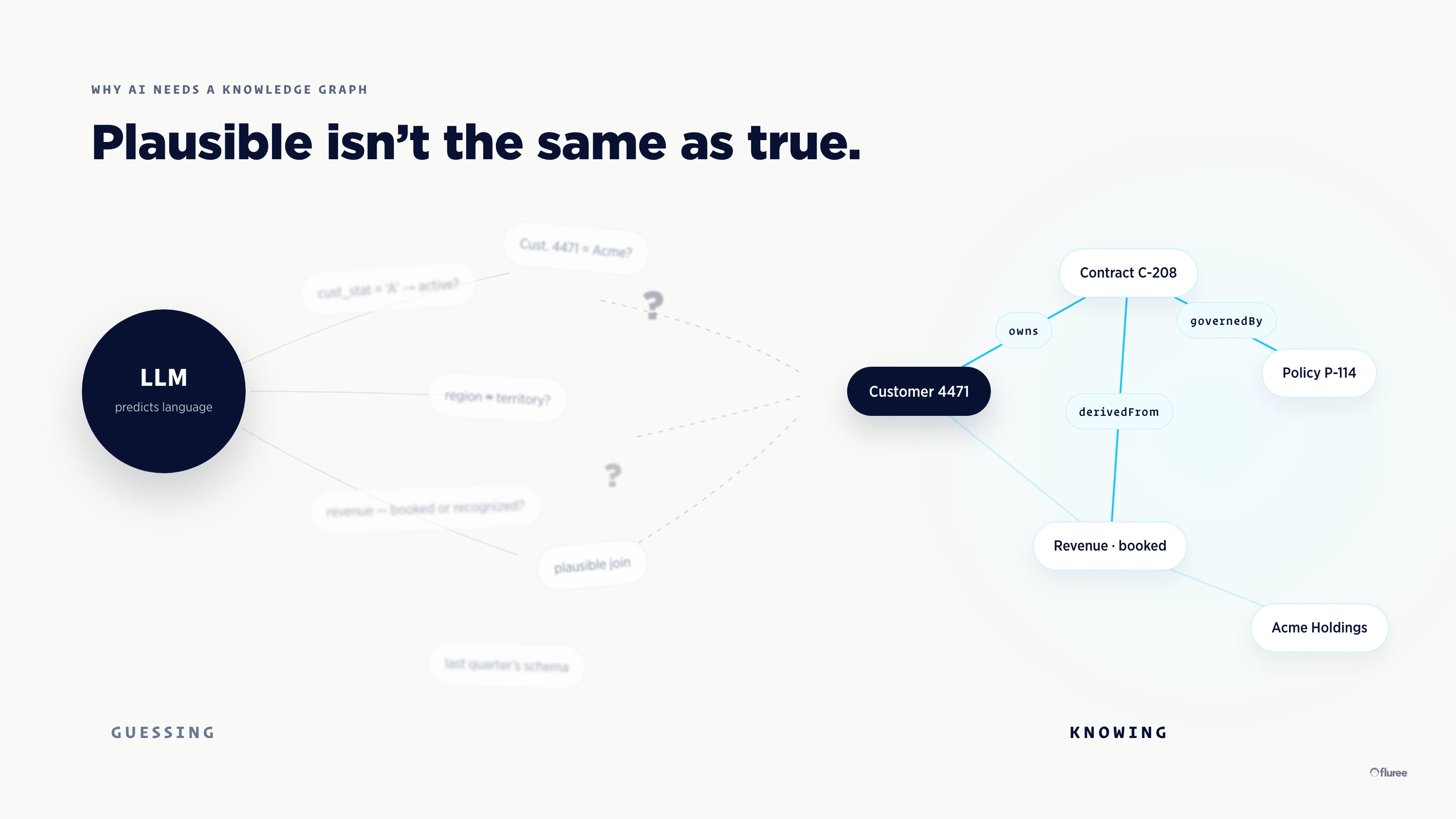
But it breaks down when questions require understanding relationships between entities. “Which suppliers serve both our European and North American operations, and which ones have had quality issues in the last quarter?” That question requires traversing relationships across procurement data, quality management records, and geographic operational data. Vector similarity search cannot reason about structured relationships. It retrieves text chunks that look similar, not data that is logically connected.

Research consistently quantifies this gap. When organizations rely on traditional relational databases for RAG, initial zero-shot accuracy typically lands around 20%, improving to roughly 80% with extensive data integration and model fine-tuning. That 80% ceiling is where most enterprise AI projects stall — as we explored in our analysis of the path toward an error-free enterprise LLM. It’s accurate enough to demo impressively, but not accurate enough to deploy in any workflow where wrong answers carry real consequences — regulatory reporting, clinical decisions, financial analysis, supply chain optimization.

Silent failures present the greatest risk. When a query executes successfully but returns semantically wrong business insights, the error appears correct while propagating false conclusions through organizational decisions. Enterprise schemas employ non-intuitive abbreviations absent from LLM training data, hide semantic meaning requiring domain knowledge, and feature relationship complexity spanning five to ten table joins with implicit relationships that LLMs must infer without guidance. Without explicit schema awareness, LLMs consistently hallucinate non-existent tables and columns, fabricate business metrics, use incorrect join logic, and omit critical filters.

Knowledge Graphs: The Semantic Layer That AI Can Reason Over

This is where the architecture choice matters. The term “semantic layer” gets applied to a wide range of technologies — from BI metric stores to data catalogs to ontology platforms. Not all semantic layers are created equal when it comes to AI readiness.

A knowledge graph-based semantic layer solves the harder problem upstream: unifying and connecting data across heterogeneous sources before any query is written. Knowledge graphs represent data as interconnected entities and relationships — customers connected to orders connected to products connected to suppliers — using an ontology that defines what each concept means and how they relate. This is fundamentally different from rows in tables. It’s a model that mirrors how business knowledge actually works.

Gartner recently designated knowledge graphs as a “Critical Enabler” with immediate impact on Generative AI. The approach they enable — often called GraphRAG — refers to retrieval augmented generation where information retrieval is based on a structured, hierarchical knowledge graph rather than flat vector similarity. Instead of retrieving text chunks that look relevant, GraphRAG traverses explicit relationships to find data that is relevant.

The accuracy improvement is dramatic. Fluree’s research on GraphRAG accuracy shows that systems using semantic knowledge graphs achieve accuracy consistently reaching 90–99% on enterprise data tasks — compared to the ~80% ceiling of centralized relational approaches and the ~20% baseline of naive RAG against raw databases. Multiple independent analyses have confirmed the trend: structured knowledge graph retrieval can improve LLM accuracy by 54% or more on average, and significantly higher on complex multi-hop queries.

Unlike a normal knowledge graph used solely for data modeling, a semantic layer built on knowledge graphs can also translate business questions into correct and optimized queries — combining the structured relationship reasoning of graph technology with the governed metric definitions of traditional semantic layers. Providing your LLM with linked data is like giving it not just a direction, but a detailed map and compass to follow precise, step-by-step instructions. This makes AI agents more accurate, reduces error rates, speeds up retrieval through caching, and keeps data usage consistent and secure.

Comparing semantic layer approaches for enterprise AI

Capability BI semantic layer Vector RAG Knowledge graph / GraphRAG
Metric consistency Excellent None Excellent
Multi-source data unification Limited (warehouse-first) Document-only Native (any source)
Relationship reasoning SQL joins only None (similarity) Multi-hop graph traversal
Enterprise AI accuracy ~80% (query layer) ~60–80% 90–99%+
Data-centric security Role-based (tool level) Minimal Embedded policy enforcement
Explainability / lineage Query audit trail Chunk attribution Full provenance + audit trail
Handles structured + unstructured Structured only Unstructured only Both, semantically linked
Agentic AI readiness Query translation Retrieval only Full reasoning + action

The Real Enterprise AI Problem: Disconnected Data, Not Insufficient Models

If you’re a CDO, CTO, or VP of Data looking at these numbers and thinking “we have this problem,” you’re not alone. The Cloudera/HBR study found that 73% of organizations say they should prioritize AI data quality more than they currently do. Siloed data and difficulty integrating data sources was the number-one obstacle cited by 56% of respondents. Only 23% have an established data strategy for AI, though more than half are actively developing one.

The problem compounds across every data silo. What Finance calls a “client” is what Marketing’s CRM calls a “customer” and what the ERP calls an “account.” Each system has its own schema, its own terminology, its own logic for calculating what should be the same metric. When you deploy RAG on top of all these systems as they exist today, you might get plausible answers, but they can’t be fully trusted. You get duplicates. You miss the complete picture. And critically, you get hallucinations that arrive dressed in the confidence of machine-generated prose.

This isn’t just a data quality problem — it’s a change management problem. Research on enterprise AI adoption shows that while 91% of organizations acknowledge a reliable data foundation is essential for AI success, only 55% believe they actually possess one. One of the biggest challenges in building a semantic layer is unclear responsibilities between business, data, and IT teams, which leads to confusion and slow progress. Translating complex business ideas into technical metadata is difficult, especially when data is scattered across different systems with varying quality. If the semantic layer isn’t aligned with the company’s overall data strategy, there’s a risk it becomes an isolated project. And without proper organizational buy-in, user acceptance will be lacking, limiting the potential impact.

A knowledge graph-based semantic layer resolves the data unification challenge by establishing a universal ontology — a shared set of concepts, terms, and relationships that is unique to your business. Once defined, data from any source can be classified against that ontology, duplicate entities resolved, and relationships formed across previously disconnected information. The result is not just a better search index. It’s what we call an enterprise knowledge fabric: a unified, semantically interconnected representation of everything your organization knows — the corporate memory that makes AI truly context-aware.

Building Your Semantic Layer: A Practical Framework

The path from disconnected data silos to a production-ready semantic layer involves three architectural stages. The good news: modern tooling has compressed what used to be an 18-month data integration project into a timeline measured in weeks.

The most effective implementation approach follows an iterative operating model — alternating between design releases (understanding user needs, defining use cases, creating semantic models aligned with business priorities) and development releases (turning those designs into working prototypes for rapid testing). These cycles build up to a Minimum Viable Product that combines several use cases into a single scalable platform, rather than attempting a boil-the-ocean rollout.

Stage 1: Define Your Semantic Model

Start with an ontology — the blueprint of global terms and concepts that define your business domain. If your organization doesn’t have one (most don’t), you have two practical starting points. First, you can adopt an off-the-shelf upper ontology like gist for broad business concepts or a domain-specific standard like Allotrope for pharmaceutical manufacturing or FIBO for financial services. Second, you can use machine learning and generative AI to reverse-engineer an ontology from your existing taxonomies, schemas, and data dictionaries. In practice, the most effective approach combines both: start with an industry standard, then refine it with AI-assisted discovery of your organization’s unique terminology and relationships.

Semantic models are typically expressed using W3C-standard formats like JSON-LD — a JSON-based serialization for linked data that allows structured data to be mixed, interconnected, and shared across different applications while remaining readable by both developers and machines.

Key actions at this stage:

  • Identify high-impact use cases where data is fragmented and the business impact is clear — sales analytics, customer intelligence, regulatory reporting
  • Define business KPIs and assign ownership to business leaders (not just the data team)
  • Involve subject matter experts early to ensure ontology alignment with how the business actually operates
  • Establish a business glossary that aligns technical and business language

Stage 2: Classify and Connect Your Data

With an ontology defined, the next step is classifying instance data — your actual enterprise information — against that semantic model. This means ingesting structured data from relational databases, ERPs, and CRMs alongside unstructured content like PDFs, audio transcripts, SharePoint documents, and emails. Each piece of information gets classified against the ontology, duplicate entities get resolved, and relationships form across previously disconnected data.

Modern semantic platforms automate much of this work through ML-powered auto-classification and entity resolution. The key architectural decision is whether to physically consolidate data into a single graph (centralized approach) or to federate across existing systems using semantic links (decentralized approach).

There are three primary architectural patterns for implementing a semantic layer:

  • Metadata-first logical architecture — Creates a virtual semantic layer that connects to existing data sources using metadata, keeping data decentralized but semantically consistent. Best for organizations that need to move fast without disrupting existing systems.
  • Built-for-purpose architecture — Each team builds and manages its own semantic layer within their tools (CRMs, BI dashboards). Fast to set up, but risks creating new silos and inconsistent definitions.
  • Centralized architecture — The semantic layer is built into a central data platform as the single source of truth. Strongest governance and standardization, but requires more planning and investment upfront.

The decentralized/federated model deserves particular attention for enterprise AI because it avoids the cost and latency of massive ETL pipelines and solves critical challenges around data sovereignty, cross-border compliance, and regulatory restrictions that prevent certain data from being moved at all.

Stage 3: Deploy for AI Consumption

A semantic layer is only valuable if AI systems can use it. The deployment layer connects your knowledge graph to LLMs, AI agents, and analytics tools through standardized interfaces. The Model Context Protocol (MCP) — now widely adopted as the “USB-C port for AI” — provides a unified way for AI tools to connect to data sources. But MCP alone is connectivity, not intelligence. As we explored in Reshaping Business Intelligence with GraphRAG, MCP, and LLMs, without a smart retrieval layer, MCP opens all the valves to your data without providing a map or filter. Knowledge graphs provide that intelligence layer: given a query, the graph knows which data to retrieve and why it’s relevant, because the relationships are explicit.

This is where the concept of an agentic semantic layer becomes critical. As AI agents advance from simple question-answering toward autonomous decision-making — placing orders, adjusting pricing, triaging support tickets — they need more than consistent definitions. They need structured, meaningful information that includes business rules, data relationships, and semantic context organized in a way that supports not just retrieval but reasoning and action. A knowledge graph provides exactly this: it doesn’t just answer “what is our revenue by region?” — it can also trace why the number is what it is, how it was calculated, and what constraints should govern any action taken on that information.

Critically, deployment must include data-centric security — policies embedded directly at the data layer that programmatically enforce who can see what, even as AI agents query in real time. This prevents the scenario flagged in the 2026 Thales Data Threat Report, where only 34% of organizations know where all their data resides even as they give AI systems broad access to enterprise information.

Measuring success across all three stages:

  • Track user adoption rates across business and technical teams
  • Monitor data accuracy and consistency metrics
  • Measure time-to-insight (how quickly teams can go from question to trusted answer)
  • Assess AI model accuracy improvements pre- and post-semantic layer deployment
  • Build data literacy programs to empower users across the organization to interpret and act on semantic layer outputs

Why 2026 Is the Inflection Point

Three converging forces make this the year the semantic layer moves from the data team’s wish list to the C-suite’s priority list.

Agentic AI demands grounded data. As organizations move from chatbot-style LLM interfaces to autonomous AI agents that take actions, the cost of hallucination shifts from “annoying” to “dangerous.” An agent connected to your ERP via MCP that misunderstands your pricing logic doesn’t just give a bad answer; it makes a bad decision. AI agents don’t just analyze data — they make decisions and take action. Without a semantic layer, they might misunderstand the data or make mistakes. With one in place, they get clear, consistent definitions, faster access to the right information, and built-in security. Semantic grounding is the control layer that makes agentic AI safe enough to deploy.

Regulatory pressure is accelerating. The EU AI Act, DORA, and expanding data sovereignty requirements demand explainability, audit trails, and governance built into AI systems by design. A semantic layer with full data lineage and provenance tracking isn’t just good architecture — it’s compliance infrastructure. Built-in governance tools track where data comes from and who changed what, which is key for compliance with frameworks like HIPAA, GDPR, and sector-specific regulations.

The cost of inaction is compounding. Organizations that deployed AI on weak data foundations are now facing a difficult choice: continue investing in systems that underdeliver, or pause to rebuild. That rebuild typically takes 12–18 months. Organizations that build the semantic foundation first — investing 47% of budget in foundations versus 18% in failed projects, per Pertama Partners’ analysis — achieve dramatically higher success rates and faster time to value. Deloitte’s State of AI in the Enterprise 2026 reinforces this point: forward-thinking organizations are converging operational, experiential, and external data flows into unified platforms that anticipate the needs of emerging AI workloads. The era of looking beyond SaaS for AI business transformation is here.

How Fluree Approaches the Semantic Layer for Enterprise AI

Fluree’s platform is purpose-built for the kind of semantic layer described in this guide: a decentralized knowledge graph that serves as the unified data foundation for enterprise AI. Named a 2024 Gartner Cool Vendor in Data Management for GenAI, Fluree’s approach addresses the full lifecycle — from ontology modeling and data classification through secure, real-time AI deployment.

The platform integrates four capabilities into a single semantic data management suite:

  • Fluree ITM handles intelligent taxonomy and ontology modeling, providing the semantic blueprint — the formal model of entities, attributes, and relationships that captures your business domain.
  • Fluree Sense uses AI/ML pipelines to automatically classify, enrich, and interconnect structured data from legacy systems — transforming relational databases, ERPs, and CRMs into semantically linked knowledge.
  • Fluree CAM applies NLP and machine learning to detect, categorize, and link unstructured content — PDFs, audio, video, SharePoint documents — against the enterprise ontology, bridging the structured/unstructured divide that has held enterprises back for decades.
  • Fluree Core, the semantic knowledge graph database, stores all of this as a unified, interconnected knowledge base with built-in security policies and cryptographic data lineage.

The architectural differentiator is decentralization. Rather than requiring organizations to physically move all data into a single centralized graph, Fluree’s decentralized knowledge graph can semantically link data wherever it lives — across on-premises systems, multiple clouds, partner ecosystems, and geographic boundaries. In research comparing RAG approaches, decentralized knowledge graphs consistently achieved the highest accuracy (90–99%), precisely because they can access data that centralized approaches cannot reach due to privacy, sovereignty, or compliance constraints.

Fluree runs on any infrastructure — on-premises, AWS, Azure, Snowflake, Databricks — and connects to any data source, from Oracle and SAP to PDFs and APIs. Embedded security policies enforce data access at the graph layer, meaning an AI agent querying through MCP or any other interface cannot access data it is not authorized to see. Every query result carries full provenance, so AI-generated answers are explainable and traceable back to their sources.

For a deeper technical exploration of how this works in practice, see the Semantic GraphRAG Whitepaper and our guide to making your data AI-ready for 2026.

Start with the Data, Not the Model

The enterprises that succeed with AI in the next decade will not be those deploying the most models. They will be the ones whose models operate from a common, governed, semantic foundation.

Building that foundation starts with an honest assessment: audit your current data landscape, identify the silos, and evaluate how much of your enterprise knowledge is actually accessible, semantically connected, and governed to the level AI demands. Then prioritize building a unified semantic layer — beginning with an enterprise ontology and structuring your most critical data as a knowledge graph that AI agents can query with confidence. Start with focused, high-impact use cases to show quick wins and build momentum. A modular, business-aligned approach enables scalable self-service analytics, encourages adoption, and lays the foundation for long-term strategic value.

The organizations getting this right are seeing the difference: not just incremental accuracy improvements, but the kind of step-function change — from 80% to 95%+ — that turns enterprise AI from an expensive experiment into a genuine competitive advantage.

Ready to Build Your Semantic Layer?

Download the Semantic GraphRAG Whitepaper → to explore the architecture in detail.

Book a Call with an Expert → to discuss how Fluree can help your organization build the data foundation for enterprise AI.