Agentic Memory, Priced: Why Fluree Memory Is the Token-Efficient Way to Give Agents Context

A companion to The Tokenomics of Enterprise AI. The cost story has a root cause — how agents carry context between steps. This is the part that fixes it: agentic memory, done as a governed graph instead of a growing prompt.
The transcript is the tax
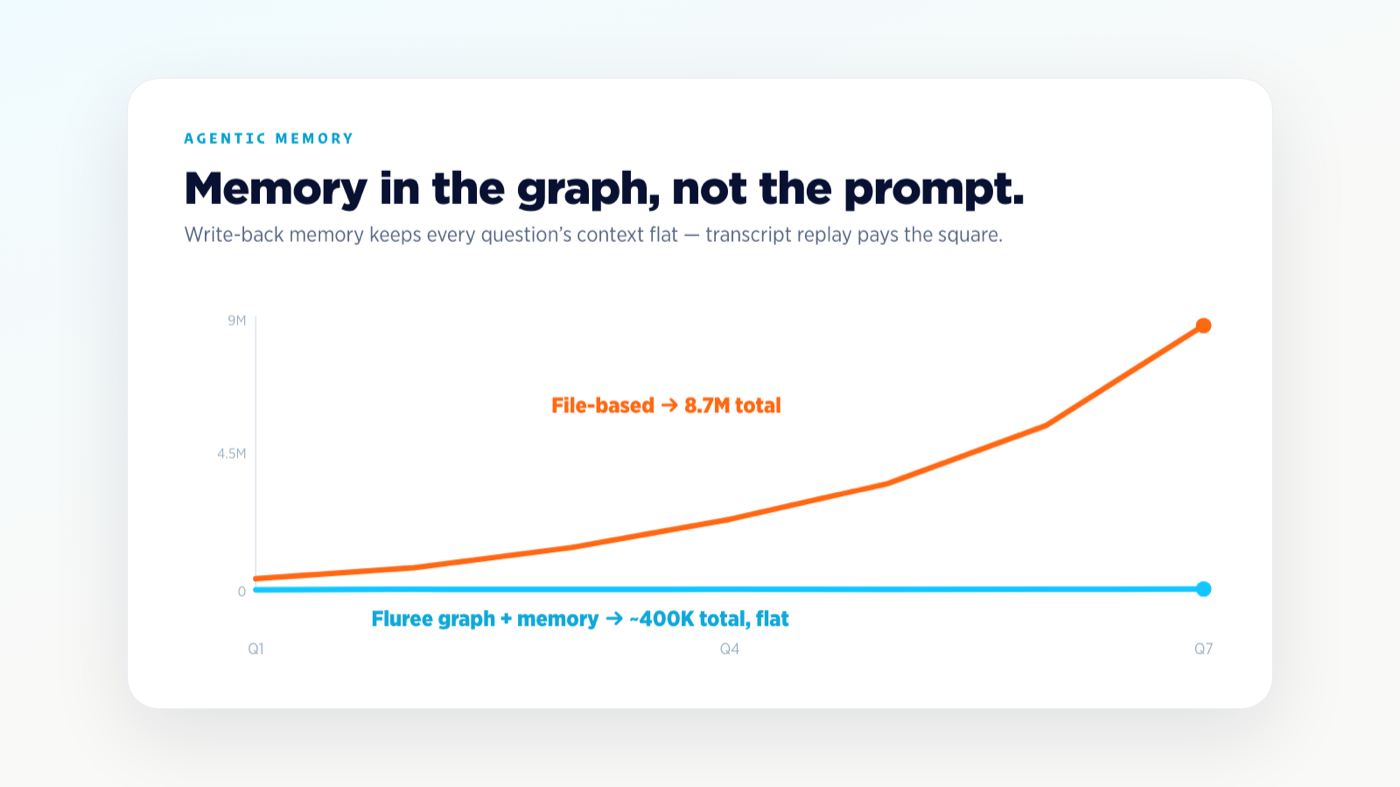
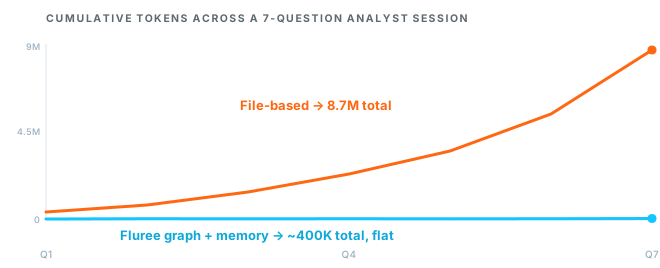
In our main TCO whitepaper, we traced why enterprise AI bills tripled even as per-token prices collapsed 99.7%: agentic workflows fan a single question into many model calls, and every call re-sends the entire conversation so far. The model has no memory between calls — so you pay to tell it everything, every time. Context grows with each turn, and because the whole thread is re-read on every step, cost grows with roughly the square of the conversation.
That quadratic is not a model problem. It’s a memory problem. The model is being asked to do a job it was never designed for: act as the durable store for everything the agent has learned. Stuff enough history into the context window and you’re paying frontier-token rates to re-read state that should live somewhere cheap, persistent, and queryable.
Fluree Memory is that somewhere. It’s a persistent, searchable knowledge store that holds an agent’s facts, decisions, constraints, preferences, and references — and hands back only the few that matter for the question in front of it. The result is the flat ~57K-tokens-per-question line in the TCO model, instead of the file-based curve that climbs to 2.1M tokens by question seven.
This piece explains, concretely, how that efficiency happens. (Want to pressure-test the dollars against your own seat mix first? Open the Agent TCO calculator.)
Where most agents keep their memory — and why it’s expensive
There are three common ways to give an agent continuity across a session or a project, and the first two are quietly metered.
Replay the whole transcript. The default. Every turn re-sends the full history. Simple, and it works — until the thread gets long, at which point you’re re-billing the entire conversation on every step. This is the pattern that compounds quadratically.
Embed everything in a vector store. Better, but it trades one cost for another. You chunk documents, embed them, and retrieve “similar” chunks at query time. The chunks still land in the context window as raw text the model must read and synthesize, and similarity retrieval has no notion of what kind of thing it found or whether it’s still true. As the main piece notes, traditional RAG feeds raw text to the model and asks it to infer — which is where both the tokens and the hallucinations come from.
Write structured memory back to a graph, recall a compact summary. This is the Fluree Memory approach — agentic memory as a governed store rather than an ever-longer prompt — and it’s the one that breaks the curve. The agent doesn’t re-read the transcript and doesn’t dump chunks into context. It runs a keyword recall against a small memory store and gets back a handful of typed, scored facts — a few hundred tokens — then resets. The next question starts from near-zero again.
The difference isn’t subtle. It’s the difference between carrying your whole filing cabinet into every meeting and pulling the one folder you need.
How recall stays small: the mechanism
The token efficiency comes from four design choices, each verifiable in the Fluree Memory guide.
Recall returns a ranked shortlist, not the archive
When an agent asks for context, Fluree Memory runs BM25 keyword scoring against the stored content — a SPARQL query against a local __memory ledger — and returns only the top matches. A recall for “how to run tests” comes back as two or three scored facts, not the entire memory store. You control the count (-n 10), filter by kind or tag, and paginate. The store can hold thousands of memories; the context window only ever sees the relevant few.
The payload is compressed by design
What the agent actually receives is a tight, machine-readable block — a <memory-context> envelope with each memory as a short element carrying its content, kind, tags, and relevance score. There’s no prose framing, no restated question, no document boilerplate. And when results are truncated, a single <pagination> element tells the agent how many memories exist and whether fetching more is even worth it (it includes the next match’s score). The agent spends tokens fetching more only when the marginal context is likely to matter — a built-in byte budget rather than an open tap.
Memories supersede instead of accumulate
Update a memory and Fluree Memory creates a new version linked to the old one via mem:supersedes. The outdated fact stops showing up in recall — so the store doesn’t bloat with stale, contradictory context that the model would otherwise have to read and reconcile. The full chain is preserved for audit (you can explain any memory’s history), but recall only ever surfaces what’s current. Contrast that with a growing transcript, where every superseded statement is still sitting there, still being re-read, still being billed.
Scope keeps the context relevant, not just small
Every memory is scoped — repo (shared with the team, git-tracked) or user (private to the developer) — and tagged by kind: fact, decision, constraint, preference, artifact. Because recall can filter on these, an agent pulls the right slice rather than a broad semantic neighborhood. Smaller, sharper context isn’t just cheaper; it’s more accurate, because the model isn’t sifting signal from a pile of loosely-related chunks.
Write-back: the part that makes the next question cheap
Efficiency on a single recall is good. The compounding win is write-back — and it’s what the main TCO model captures as “context resets to near-zero” on each new question.
When an agent finishes a piece of work — validates a query, settles a design decision, learns a constraint — it writes that finding back to the memory graph as a typed memory. The knowledge doesn’t evaporate when the context window clears. The next session, or the next teammate’s agent, recalls a compact summary of what was already learned instead of re-deriving it from raw data and a fresh transcript.
This is the difference between memory that accumulates in the prompt (linear-to-quadratic token growth, paid every turn) and memory that accumulates in a graph (constant recall cost, written once, reused indefinitely). A team of agents working a shared repo builds a compounding institutional memory in plain-text Turtle under version control — git pull brings teammates’ memories with it, and the local ledger rebuilds automatically. The knowledge base grows; the per-question token cost does not.
That’s the same “build once, share” economics from the main piece, applied to the agent’s working memory rather than the analytic app: the cost of learning something is paid a single time, not re-paid by every user on every question.
It’s the same architecture as the data layer — at agent scale
Fluree Memory isn’t a bolt-on. It’s the context-in-the-loop architecture pointed at the agent’s own scratchpad. The principle is identical to the one that keeps the enterprise knowledge graph cheap to query: keep the durable, growing context in a governed store; pull a small, relevant, current slice into the model on demand; write findings back so the next question starts ahead.
Both store knowledge as RDF triples. Both recall through a query rather than a re-read. Both carry provenance — every memory has a created-at timestamp, a scope, a branch, and (for decisions) a recorded rationale and the alternatives that were considered. And both are policy-bound: memory is scoped and revocable, sensitive content is redacted before storage, and recall respects who’s allowed to see what. The thing that makes the answer cheap — query, don’t re-load — is the same thing that makes it governed and auditable.
It runs locally as a single binary, exposes itself to Claude, Cursor, or any MCP client through a native MCP server, and stores its source of truth as plain-text Turtle files you can read, diff, and commit. No vector cache to manage, no cloud dependency for recall, no proprietary memory format to get locked into.
The takeaway
The token bill in the main piece has a single root cause: agents that carry context by re-reading a growing transcript, paying frontier rates to re-tell the model what it already processed. Fluree Memory removes that root cause. It stores what the agent learns as typed, scoped, versioned facts; recalls a compact, ranked shortlist instead of the archive; supersedes stale knowledge so the store never bloats; and writes findings back so each new question starts from near-zero context.
Smaller recalls, no transcript replay, no chunk-dumping, no re-derivation. That is what keeps each question’s context flat — and a flat per-question cost is the entire reason the five-year bill stays predictable as you scale.
See it work: the Fluree Memory guide walks through setup, recall, and write-back in a few commands. Or read Context-in-the-Loop for the architecture behind it. Ready to try it? Start free.
Frequently Asked Questions
Stay in the loop
Weekly insights on enterprise AI, knowledge graphs, and data intelligence.